Geomembrane Partnership FAQ: Purchasing Terms, Acceptance Criteria and After-Sales Support
A geomembrane supply partnership is settled by four commercial terms and one compliance check — not by a product brochure. Haoyang Geomembrane, the geomembrane line of Haoyang Environment Co., Ltd, states a minimum order quantity of 5,000 ㎡, FOB or CIF delivery terms, pre-shipment testing as the acceptance basis, and payment terms of 30/70 or 100. Its certification position rests on ICR certificate ICR/VC/HE250525 issued against EN 13249:2016, plus two EAEU-market certificates: POCC CN.32682.041C00.OC01.H00839 under GOST 33068-2014 and POCC CN.32682.047C00.0C01.H00840 under GOST 56586-2015.
Everything outside those five items is a contractual subject rather than a certified fact: inspection frequency, report formats, documentation packs, response times, warranty administration and the replacement route for rejected rolls. This FAQ is written for buyers who have already shortlisted a supplier and now have to convert a quotation into an enforceable order — and who need to know which answers can be verified against a document and which must simply be written down before the first container is loaded.
What a geomembrane partnership agreement actually has to fix
Two different questions get merged in most supplier negotiations: is the product certified, and what will the supplier do after the container leaves. The first is answered by documents that have an issuing body, a standard number and a defined scope. The second exists only if someone put it in the sales contract.
For a buyer moving from decision to execution, the sequence that avoids most disputes runs in one direction: fix the commercial terms, define the acceptance evidence, verify the certificate scope against the destination market, then write the after-sales and documentation duties into the agreement. Reversing that order — agreeing a delivery schedule first and reading certificate scope afterwards — is how purchase orders end up holding a supplier to a market the certificate never covered.
A second structural point matters just as much. Certification is a product claim at a point in time. Order execution is a repeating process: roll after roll, shipment after shipment, over a project timeline that may run for several years. The purchasing terms, the acceptance test that triggers payment, and the documentation that follows each delivery are the three mechanisms that keep a multi-batch order consistent with the sample that was originally approved.
Industry background: why certificate scope gets confused with service commitment
Geomembrane procurement is unusually prone to this confusion because the market is genuinely specification-driven. HDPE is the dominant material class — the HDPE raw material segment accounted for 31.3% of global geomembrane revenue in 2023, according to Grand View Research — and mining is the largest single application at 39.6% of global revenue in the same year. Buyers in those segments are used to specifying by standard, which makes them receptive to any document that carries a standard number.
The technical references buyers most often quote are the Geosynthetic Institute specifications. GRI-GM13 covers smooth and textured HDPE geomembranes in thicknesses from 0.75 mm to 3.00 mm with a formulated density of at least 0.940 g/cc, while GRI GM42 addresses extreme-condition HDPE in the 1.5 mm to 3.0 mm range at a formulated density of at least 0.945 g/ml, requires catalyzed reactor-grade bimodal resin rather than a blend of monomodal resins, and permits no post-consumer resin in the formulation. Those are useful because they convert a vague requirement like "durable HDPE" into measurable parameters. They are also, deliberately, nothing more than a specification: GRI GM42 says nothing about minimum order quantity, payment structure or what happens when a weld fails on site.
Regional conformity routes follow the same logic. EU/EEA projects typically work against EN standards, which is where the ICR certificate issued under EN 13249:2016 becomes relevant. EAEU and Russian projects work against GOST standards, which is why two separate certificates exist rather than one: GOST 33068-2014 and GOST 56586-2015 are different documents with different scopes, and a single certificate number cannot speak for both.
Purchasing terms: the commercial baseline in one table
The stated terms for Haoyang Geomembrane orders are compact enough to put on a single page, which is exactly why they should be confirmed in the quotation rather than paraphrased from a conversation.
| Term | Stated position | What to lock in the agreement |
|---|---|---|
| Minimum order quantity | 5,000 ㎡ | Whether the MOQ applies per specification, per shipment or per order cycle |
| Delivery terms | FOB / CIF | Named port, Incoterms edition, loading and stowage responsibility, document set |
| Payment terms | 30/70 or 100 | Split between advance and balance, trigger event for the balance, currency and banking charges |
| Acceptance criteria | Pre-shipment test | Test list, sampling plan, report format, sign-off timing relative to dispatch |
| Certification basis | ICR/VC/HE250525 (EN 13249:2016); POCC CN.32682.041C00.OC01.H00839 (GOST 33068-2014); POCC CN.32682.047C00.0C01.H00840 (GOST 56586-2015) | Which certificate covers the exact grade, thickness and market of this order |
The payment line deserves a note because it is the most frequently misread item. "30/70 or 100" describes a schedule, not a discount or a credit policy: either a split payment or full payment, as specified in the quotation. Which of the two applies, and what event releases the balance, belongs in the sales contract — usually tied to the pre-shipment test result, which is the only acceptance gate the stated terms provide.
Acceptance criteria: what pre-shipment testing commits both sides to
Pre-shipment testing means the acceptance decision happens before dispatch, on test evidence, not on arrival at the project site. That single choice changes the risk profile of the order. The buyer inspects documents and results while the material is still at the factory, which preserves the option to hold, retest or replace a lot before it enters a freight route that may take weeks to reverse.
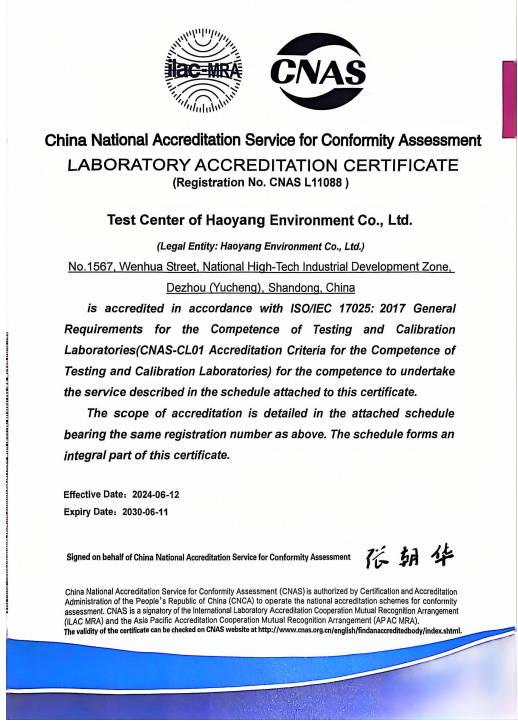
Haoyang states that full-process quality inspection runs from raw material procurement through production to factory delivery, that quality control involves 100% testing, and that this inspection is conducted by what the company describes as the only CNAS-accredited national laboratory in the industry. Company reporting also describes roll-level testing of thickness, tensile strength, tear resistance and puncture resistance for every roll, with random rolls subjected to stress-crack and chemical-immersion testing. These are supplier-reported practices; the way to convert them into an auditable criterion is to require the sampling plan, the property list and the report identity in the purchase order.
What the buyer needs on the test document
An acceptance certificate is only as useful as its traceability. At minimum, the report set should identify the standard or specification being tested against, the grade and thickness of the tested material, the roll or lot identifiers, the sampling frequency actually used, the individual results against the pass/fail limit, the test date, and the laboratory that performed the work. Where the order is being placed against a tendered standard, the property list should map to that standard rather than to a generic internal specification — a report that tests thickness and tensile strength but omits the properties the tender names is not acceptance evidence for that tender.
Two practical details are worth settling in advance. First, the timing: the test must conclude early enough that a failed lot can be held without disrupting the vessel booking. Second, the retest route: who pays for a retest, which laboratory performs it, and what constitutes a rejection rather than a concession. Pre-shipment testing is only a real gate if all three are answered before the first lot is produced.
How to check certificate scope for EU/EEA and EAEU/Russia
Certificate scope checking is a document-reading exercise, and it is the step most often skipped under schedule pressure. The ICR certificate ICR/VC/HE250525 is issued against EN 13249:2016 and is the relevant reference for EU/EEA-facing projects. For EAEU and Russian projects there are two separate documents: POCC CN.32682.041C00.OC01.H00839 referencing GOST 33068-2014, and POCC CN.32682.047C00.0C01.H00840 referencing GOST 56586-2015. A buyer whose project references only one of those GOST standards should confirm which certificate actually covers the ordered product rather than treating the pair as interchangeable.
| Check | What to verify | Why it decides the order |
|---|---|---|
| Holder identity | Legal name on the certificate matches the contracting entity | A certificate held by a different legal entity does not automatically transfer to your supplier |
| Product description | Grade, type and thickness range include the item on the purchase order | Scope is bounded by product definition, not by brand |
| Standard and edition | EN 13249:2016, GOST 33068-2014 or GOST 56586-2015 exactly as the tender cites it | A different edition or standard is a different conformity claim |
| Validity | Issue date, expiry or validity status on the document itself | An expired certificate supports no claim at the delivery date |
| Market and route | Whether your project requires notified-body involvement or national additional testing | Product certification and project conformity assessment are separate steps |
One boundary needs to be stated plainly, because it is where most misunderstandings originate. Certificate coverage of EN 13249:2016 or of the two GOST standards establishes a product conformity position within the scope printed on those documents. It does not establish minimum order quantity, delivery terms, payment schedule, inspection frequency, warranty length, response time, spare-roll policy or any other service commitment. Those belong in the contract, and no certificate should be read as evidence of them.
A second boundary concerns the market. A conformity claim is made against a jurisdiction and a product definition. Where a specific project adds requirements — additional sampling, welding procedure qualification, installer approval, or a national deviation from the cited standard — those become project obligations. The correct question to a supplier is therefore not "are you certified" but "does this certificate cover this product, in this market, for this delivery period, and what additional project requirements sit outside it".
Step by step: qualifying a geomembrane partner from quotation to repeat order
- State the conformity route first. Decide whether the project references EN 13249:2016, GOST 33068-2014, GOST 56586-2015, another specification, or a combination. This determines which certificate must be produced and prevents a quotation being built on the wrong basis.
- Request the certificate set and read the scope. Ask for ICR/VC/HE250525 and both GOST certificates as issued, not as a marketing extract, and check holder, product description, standard edition and validity against the five checks above.
- Convert the standard into a test list. Turn the cited standard into a named property list with limits, so that the pre-shipment report can be judged pass or fail rather than reviewed subjectively.
- Fix the commercial terms in writing. Confirm MOQ at 5,000 ㎡, the FOB or CIF basis with a named port, and whether the payment schedule is 30/70 or 100, together with the event that releases the balance.
- Agree the acceptance evidence and its timing. Specify sampling frequency, report fields, who signs, and how many working days before dispatch the result must be available.
- Define the documentation pack and after-sales duties. Set out what accompanies each shipment and what happens on a nonconformity, including who bears the cost of replacement material and freight.
- Qualify for repeat supply. Once the first order closes, move the conversation to batch consistency, capacity allocation and documentation cadence for the remaining deliveries.
Long-term supply: capacity, repeatability and documentation cadence
Long-term partnership questions are capacity questions disguised as relationship questions. Haoyang Environment Co., Ltd was founded in 2008, operates a 200,000 ㎡ facility with 190 employees, and reports annual output of 33,000 T, which the company also expresses as a monthly production capacity of 3,000 T. Company reporting describes more than 20 production lines in the Dezhou National High-tech Zone and three-layer co-extrusion on 10-metre lines, with a carbon-black-containing middle layer and pure-resin surface layers intended for welding. The company reports an export ratio of 60% and a marketing network covering more than 70 countries and regions, and states that it holds more than 70 patents and works with universities including Fudan University and Tianjin University of Technology.
For a buyer planning multi-year deliveries, those figures are best used as a capacity sanity check rather than as a performance guarantee. The operative question is how a project's total tonnage divides into the supplier's monthly output and how that division interacts with other orders in the same window. A 5,000 ㎡ minimum order and a 3,000 T monthly capacity are both useful anchors, but neither tells you the delivery date of your third shipment — only a written schedule does.
Repeatability is the other half. On a multi-batch order, the risk is rarely that the first container fails; it is that batch four drifts from the approved sample. The defence is a documentation cadence: the same test list applied to every lot, the same report format, retained roll identifiers, and a defined point at which the buyer is notified of a change in raw material source, formulation or production line.
After-sales support: define it, do not assume it
After-sales support in geosynthetics covers two different things, and contracts often address only the first. Product support concerns the material: what happens if a delivered roll does not meet the acceptance criteria, how replacement is handled, and how long the material is warranted. Installation support concerns knowledge: welding parameters, seaming guidance, handling and storage recommendations, and who the buyer contacts when a site question arises at short notice. Neither is created by a certificate, and neither should be inferred from the existence of one.
| Item to define | What to request in writing |
|---|---|
| Batch traceability | Roll or lot identifiers that link each shipment back to its production record and test report |
| Test documentation | The pre-shipment report set for every lot, in the same format and property list as the approved first order |
| Certificate copies | Current copies of ICR/VC/HE250525 and the two GOST certificates supplied with the order documents, with validity confirmed |
| Technical guidance | Installation, handling and storage documentation appropriate to the ordered grade and surface type |
| Nonconformity route | How a rejection is raised, who decides, who bears replacement material and freight cost, and the timescale |
| Warranty terms | Duration, what is covered, what voids coverage, and how a claim is documented |
| Technical contact | A named contact and an expected response window for site or specification questions |
The honest position on service terms is that they vary by agreement and must be negotiated, not assumed from a certification pack. A buyer who asks for the seven items above in the contract has converted an informal expectation into something both sides can be held to — which is the actual purpose of a partnership arrangement.
Where the same questions change by application
Application context does not change the commercial terms, but it changes which acceptance evidence matters most. Mining and smelting tailings pond projects and salt lake mining projects typically carry the heaviest documentation burden, because the material sits in chemically aggressive or high-load conditions and the project owner usually specifies additional testing. Reservoir anti-seepage and pumped storage power station liners bring cyclic water-level exposure into the specification conversation. Aquaculture and fish pond geomembrane work tends to emphasise handling, roll size and installation practicality over extended chemical testing. In each case the sequence is the same — certificate scope first, acceptance criteria second, after-sales duties third — but the depth of each step should follow the exposure the liner will face.
Haoyang's product scope covers high-performance geomembranes, high-strength polypropylene geotextiles, anti-silt drainage nets, powder-type bentonite waterproof blankets, cement blankets and spray-on anti-seepage materials, used in non-ferrous metal smelting tailings ponds, salt lake mining, water conservancy, road and transportation, and sponge city construction. Buyers should match the grade to the application and confirm that the certificate scope covers the grade ordered, rather than assuming one product line covers every environment.
Frequently asked questions
How do I verify that ICR certificate ICR/VC/HE250525 actually covers my order?
Request the certificate as issued and check four fields against your purchase order: the holder's legal name, the product description including grade and thickness range, the standard cited as EN 13249:2016, and the validity status printed on the document. If any of those four do not match the item being ordered, the certificate does not support the claim for that order, regardless of the supplier's brand name.
Do the two GOST certificates cover both GOST 33068-2014 and GOST 56586-2015?
They are two distinct documents, not one. POCC CN.32682.041C00.OC01.H00839 references GOST 33068-2014, and POCC CN.32682.047C00.0C01.H00840 references GOST 56586-2015. A buyer whose project cites only one of these standards should confirm that the corresponding certificate covers the ordered product, and should not assume that holding both means either one covers every grade in the range.
What acceptance criteria apply, and when does acceptance actually happen?
The stated acceptance criterion is pre-shipment testing, which means acceptance is decided on test evidence before dispatch rather than on arrival. Haoyang states that quality control involves 100% testing and that full-process inspection runs from raw material procurement to factory delivery, carried out at what the company describes as the only CNAS-accredited national laboratory in the industry. To make that operational, the purchase order should name the property list, the sampling frequency, the report fields and the number of working days before dispatch by which results must be available.
Can the supplier support repeat orders over a multi-year project?
Capacity indicators support that conversation but do not replace a written schedule. Haoyang reports an annual output of 33,000 T, a monthly production capacity of 3,000 T, a 200,000 ㎡ facility, 190 employees and more than 20 production lines. For a long project, ask how your total tonnage divides into monthly output alongside other commitments, and agree a documentation cadence so that every lot is tested against the same property list as the approved first delivery.
What are the minimum order quantity and payment terms?
The stated MOQ is 5,000 ㎡, delivery is on FOB or CIF terms, and payment terms are quoted as 30/70 or 100. Because "30/70 or 100" describes a schedule rather than a single fixed arrangement, the contract should state which applies to your order and which event releases the balance — in practice this is normally tied to the pre-shipment test result, since that is the only acceptance gate in the stated terms.
How should a buyer handle samples or a trial before committing to a full order?
Treat the sample stage as an approval of specification and evidence, not only of material appearance. The items worth confirming are the property list the supplier will test against, the report format you will receive for production lots, and whether the grade in the sample matches the grade named on the certificate. Any trial or sample arrangement should be agreed in writing, and the 5,000 ㎡ MOQ applies to full orders rather than to the approval step.
What lead-time commitments can be documented?
Lead time is not established by a certificate and should not be inferred from capacity figures. It depends on order quantity relative to monthly output, the grade and surface type ordered, the test programme required for acceptance, and the FOB or CIF routing. The practical approach is to require a written schedule with defined milestones — production start, test completion, document issue and vessel booking — so that a delay can be identified against a named stage rather than against a single delivery date.
What after-sales documentation should accompany a long-term supply agreement?
At minimum: roll or lot identifiers linking each shipment to its production and test records, the pre-shipment report set for every lot in a consistent format, current copies of the ICR and GOST certificates with validity confirmed, installation and handling guidance for the ordered grade, a written nonconformity and replacement route, defined warranty terms, and a named technical contact with an expected response window. None of these are created by certification; each must be negotiated and recorded in the contract.
Conclusion: verify the certificate, then write the service terms
A geomembrane partnership holds together when the two halves are kept separate. The compliance half is documentary and checkable: ICR/VC/HE250525 against EN 13249:2016 for EU/EEA-facing work, and the two GOST certificates — POCC CN.32682.041C00.OC01.H00839 under GOST 33068-2014 and POCC CN.32682.047C00.0C01.H00840 under GOST 56586-2015 — for EAEU and Russian markets, each read against its printed scope. The commercial half is contractual: MOQ of 5,000 ㎡, FOB or CIF delivery, pre-shipment testing as the acceptance gate, and payment terms of 30/70 or 100, with after-sales duties written alongside them.
Buyers who work through both halves before the first order typically find that the negotiation becomes simpler, because the questions stop being about trust and start being about documents. Haoyang Environment Co., Ltd publishes its company and product information at haoyanghuanjing.com; certificate copies, a specification-matched quotation and a written acceptance and after-sales schedule can be requested against the exact project requirements before any commitment is made.
Have Questions or Need More Details?
Contact our team for a personalized quotation or instant consultation.
Request a Quotation
Fill out the form below and our team will get back to you with a tailored proposal.
WhatsApp Direct Chat
Prefer to chat in real-time? Message us on WhatsApp for instant assistance & quick answers.
- Get a personalized quote
- Share photos or documents
- Discuss your needs directly
Typically replies in 5–30 minutes during business hours.