Drainage Geonet vs. Geomembrane: Defining Roles in the 24/7 Metal Smelting Leak Prevention System
A geomembrane and a drainage geonet do two different jobs in the same leak prevention system. The geomembrane is the barrier that stops liquid from leaving the containment zone. The drainage geonet is the layer that collects and conveys liquid, carries compressive load, and holds its own strength under chemical exposure. Neither layer replaces the other, and specifying one without the other usually leaves a gap.
That distinction matters most in metal smelting, where containment systems run continuously. A smelting site does not get a quiet season in which the liner can be inspected at leisure. The system is in service in 24/7 operation mode, and it is designed for leakage prevention environments where the stated requirements include high chemical resistance, UV resistance and long service life. Under those conditions, the questions buyers ask are not really about which material is better. They are about which layer is responsible for which failure, and how to write a specification that assigns responsibility correctly.
The Short Answer: One Layer Blocks, the Other Layer Manages
In a metal smelting anti-seepage system, the geomembrane is the primary barrier. It is the continuous membrane that the design relies on to prevent liquid leakage. The drainage geonet is a supporting component in the same system: it provides a flow path for liquid, it resists the compressive load imposed by overlying material, and it has to retain its strength when it meets the chemical environment produced by smelting operations.
Both products are listed by Haoyang Environment Co., Ltd. as matched equipment for the metal smelting leakage prevention scenario, with the geomembrane offered in 0.3 mm to 3.0 mm thickness and the drainage geonet in 4.0 mm to 8.0 mm thickness. They are supplied as a pair because the system fails in two different ways if either role is left unassigned: a barrier without drainage accumulates liquid against itself, and drainage without a barrier simply moves liquid somewhere it should not go.
Problem Definition: What 24/7 Operation Changes About the Specification
The defining constraint in metal smelting is not the peak load. It is the absence of a pause. This product operates in 24/7 operation mode, which means the containment system is loaded, wetted and chemically exposed continuously rather than intermittently. Four practical consequences follow.
- Chemical exposure is cumulative, not episodic. The application states special requirements including high chemical resistance, UV resistance and long service life. A material that performs adequately in a short campaign may still be the wrong choice for continuous service, because the question is retained strength over time, not initial strength.
- The barrier cannot be allowed to carry load it was not designed for. When drainage is inadequate, liquid and fines accumulate and the liner is asked to behave like a drainage layer. That is a role error, not a material defect.
- Compressive load is permanent. Overlying soil, ore, residue or ballast sits on the drainage layer without relief, so the drainage geonet has to maintain its geometry — and therefore its flow capacity — under sustained compression.
- Inspection windows are short. Because the site runs continuously, verification has to be built into the specification and the acceptance criteria rather than discovered during operation.
The problem definition, then, is not geomembrane versus drainage geonet. It is whether the specification clearly separates a barrier duty from a drainage and load-bearing duty, and whether each layer is tested against the duty it actually carries.
Industry Background: Where These Two-Layer Systems Are Specified
Metal smelting containment is one of several sectors where the barrier-plus-drainage combination is standard. The application scenario described for this product line is common in Laos, Cambodia, Indonesia, Vietnam, the Democratic Republic of the Congo, the Republic of the Congo, Russia, Uzbekistan, Kyrgyzstan, Kazakhstan, Australia and Chile — a list that maps closely onto regions with active non-ferrous metal processing and tailings infrastructure.
The category itself is large enough to support dedicated product development. Commercial market research cited in the 2026 category data projects the global geonet drainage composite market to grow from USD 762 million in 2025 to USD 1,138 million in 2032, at a reported CAGR of 6.0%. That figure covers geonet drainage composites including two-dimensional and three-dimensional types; it is a market-sizing estimate from a commercial research source, not a statement about any individual supplier's volume.
Alongside smelting, the same two-layer logic appears in aquaculture pond anti-seepage systems, where the requirement set shifts to non-toxicity, UV resistance and fish-friendly service life instead of chemical aggression. The layers are the same category of product; the duty they are asked to perform is not.
The Geomembrane: What the Barrier Layer Actually Does
The geomembrane is an HDPE membrane supplied in 0.3 mm to 3.0 mm thickness, with thickness customizable. Its role in the system is unambiguous: it is the anti-seepage element, designed for leakage prevention environments and used in anti-seepage system projects. Everything else in the system either protects it or supports it.
The published mechanical and durability parameters describe a barrier that is expected to deform rather than crack, and to resist oxidation over a long service life:
| Geomembrane parameter | Published value (0.3 mm – 3.0 mm, customizable) |
|---|---|
| Material | HDPE |
| Thickness | 0.3 mm – 3.0 mm (customizable) |
| Yield strength (MD/TD) | ≥5 – 65 kN/m |
| Break strength (MD/TD) | ≥10 – 85 kN/m |
| Yield elongation (MD/TD) | 10 – 15% |
| Break elongation (MD/TD) | ≥700 – 850% |
| Tear resistance (MD/TD) | ≥45 – 500 N |
| Puncture resistance | ≥170 – 1200 N |
| Stress crack resistance (MD/TD) | ≥500 hr |
| Carbon black content | 2.0 – 2.8% |
| Standard OIT / High pressure OIT | ≥130 min / ≥430 min |
| Oven aging at 85°C (Standard OIT retained after 90 days) | ≥60% |
Read together, these values describe a barrier selected for elongation and toughness rather than stiffness. Break elongation of ≥700–850% and puncture resistance of ≥170–1200 N indicate that the membrane is intended to accommodate settlement and localized point loading without losing continuity. The stress crack resistance and OIT figures address the slower failure mode — oxidation and slow crack growth over years of continuous service, which is precisely the risk profile of a 24/7 site.
The Drainage Geonet: What the Supporting Layer Actually Does
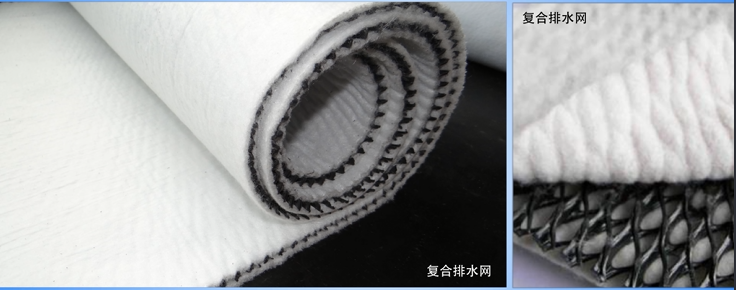
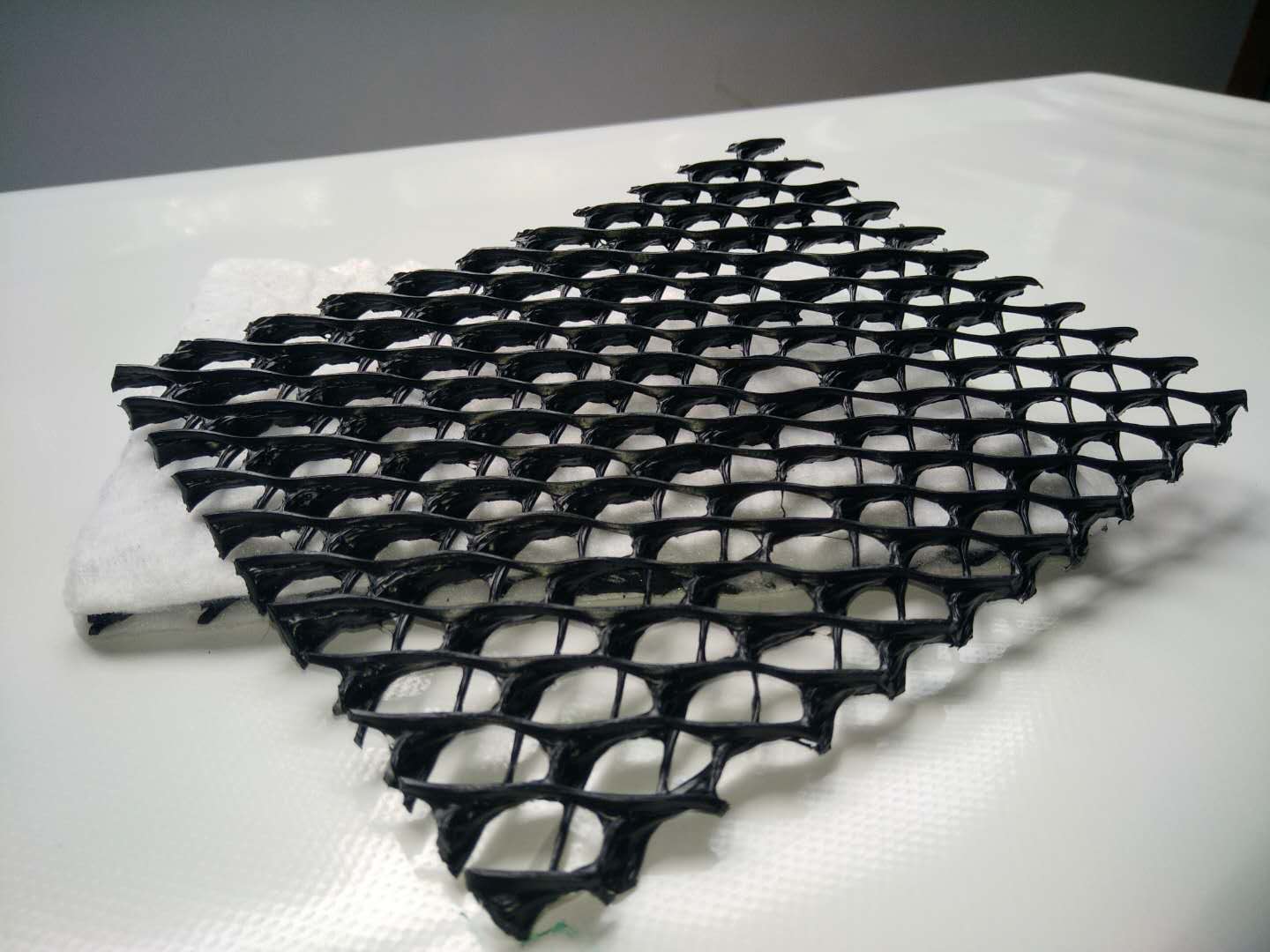
The drainage geonet is a three-dimensional drainage geosynthetic built from HDPE, PP or PET. In composite form it is supplied as a geonet core with single- or double-sided thermally bonded nonwoven geotextile — a structure described in supplier product literature as a two- or three-layer three-dimensional drainage geosynthetic, with PP/PET used for the geotextile component and HDPE for the geonet core. The published product range covers composite drainage geonet, acid and alkali resistant drainage geonet, high compressive resistance drainage geonet, high drainage capacity geonet, 3D composite drainage geonet, polyester filament composite drainage geonet and high-strength polypropylene composite drainage geonet.
Those type names are not marketing variants. Each one points at a different duty: flow capacity, compressive resistance, chemical resistance, or tensile reinforcement. The published parameter set spans all of them:
| Drainage geonet parameter | Published value (4.0 mm – 8.0 mm, customizable) |
|---|---|
| Material | HDPE / PP / PET |
| Thickness | 4.0 mm – 8.0 mm (customizable) |
| Mass per unit area | 500 – 1400 g/m² (customizable) |
| Tensile strength (MD/TD) | ≥5 – 15 kN/m |
| Elongation at break | 10 – 25% |
| Compressive strength (10% strain) | ≥500 – 830 kPa |
| Acid/alkali resistance | ≥90% strength retention |
| Drainage capacity | ≥50 – 120 (L/min)/m (customizable) |
For context, industry technical literature describes biplanar geonets at 4–8 mm thickness with transmissivity in the range of 10⁻³ to 10⁻² m²/s measured under ASTM D4716, and compressive strength of 500–1,000 kPa. The manufacturer-published compressive range of ≥500–830 kPa at 10% strain sits inside that band, which is consistent — but the two figures are not interchangeable, because the published product value does not state the test standard, loading duration or specimen configuration used to produce it.
Why the Drainage Geonet Needs Chemical Resistance of Its Own
This is the point buyers most often miss when they treat the geonet as inert hardware. In a smelting containment system, the drainage layer is not isolated from the chemistry of the site. It sits in the path of liquid that has permeated or condensed through the system, and it has to keep its geometry while doing so.
The published acid/alkali resistance figure for this drainage geonet is ≥90% strength retention. That single number defines whether the layer can still carry compressive load and maintain flow after chemical exposure — because both compressive resistance and drainage capacity are structural properties. If the polymer degrades, the 3D structure collapses, the flow path closes, and the liquid that should have been conveyed away is instead held against the geomembrane.
Two cautions apply. First, the published figure does not state the exposure medium, concentration, duration or temperature used in the test, so it functions as a screening value rather than an engineering approval. Second, the geomembrane's own long-term performance under chemical and oxidative exposure is addressed through a different set of indicators — stress crack resistance, OIT and oven aging — and cannot be inferred from the geonet's acid/alkali figure. Buyers should ask for test conditions on both, not a single pass or fail statement.
Step-by-Step: Assigning Duties in a 24/7 Smelting Containment System
The working method below separates the two layers at every stage, so that the specification, the purchase order and the acceptance test all point at the same responsible component.
Step 1 — Write the barrier duty and the drainage duty as separate line items
State the geomembrane requirement as a leakage prevention requirement: continuous barrier, anti-seepage system component, thickness selected from the 0.3 mm to 3.0 mm range. State the drainage geonet requirement as a hydraulic and load-bearing requirement: flow capacity, compressive resistance, chemical retention. When both appear as one line item described only as anti-seepage material, the supplier cannot be held to either duty.
Step 2 — Size the drainage geonet against load and flow, in that order
Compressive strength at 10% strain determines whether the flow path survives. With published values from ≥500 kPa to ≥830 kPa, the selection question is which point in that range applies under the site's actual overburden. Only after the compressive requirement is fixed should drainage capacity be checked, because flow capacity measured on an uncompressed sample does not describe a compressed layer in service. Published drainage capacity of ≥50–120 (L/min)/m is a range, not a single performance value.
Step 3 — Confirm the chemical exposure case before selecting the grade
Where the leachate or process liquid is chemically aggressive, the acid and alkali resistant drainage geonet variant is the relevant starting point, with ≥90% strength retention as the screening threshold. Where UV exposure is also present — which the application requirements list explicitly — the UV-resistant and anti-aging considerations apply to both layers, not only to the membrane.
Step 4 — Fix the geomembrane thickness and grade
Thickness selection within 0.3 mm to 3.0 mm should follow the mechanical duty: puncture resistance from ≥170 N to ≥1200 N, tear resistance from ≥45 N to ≥500 N, and the settlement the site expects. The durability indicators — stress crack resistance ≥500 hr, standard OIT ≥130 min, high pressure OIT ≥430 min, and ≥60% standard OIT retention after 90 days at 85°C — should be quoted in the purchase specification so that aging performance is a contractual property rather than an assumption.
Step 5 — Sequence installation so the barrier is never the working surface
The drainage geonet and its bonded geotextile are placed so that liquid is collected and conveyed, and so that overlying granular material does not bear directly on the membrane. Sequence and placement follow the project design; what matters at the procurement stage is that the geotextile component, the geonet core and the membrane are specified as three named components with three named duties, because on site the failure of any one is often attributed to the others.
Step 6 — Set acceptance criteria before delivery, not after
ASTM catalogue entries relevant to this category include ASTM D7931/D7931M-21a, a standard guide for specifying drainage geocomposites, and ASTM D7273/D7273M-08(2026), a standard guide for acceptance testing requirements for geonets and geonet drainage geocomposites. Both are catalogue listings of guides. Neither proves that a specific product complies, and neither replaces a project specification — but both give a buyer a defensible framework for asking what will be tested, on which sample, and against which reported basis.
Comparison Table: Geomembrane and Drainage Geonet Side by Side
The table below compares the two layers only on published facts. It is not a ranking, and it does not imply that either product is a substitute for the other.
| Comparison point | Geomembrane | Drainage geonet |
|---|---|---|
| Primary function in the system | Prevent liquid leakage; the anti-seepage barrier | Provide a drainage path and resist compressive load |
| Material | HDPE | HDPE / PP / PET |
| Thickness range | 0.3 mm – 3.0 mm (customizable) | 4.0 mm – 8.0 mm (customizable) |
| Mass per unit area | Not stated in the published product data | 500 – 1400 g/m² (customizable) |
| Governing mechanical parameters | Yield strength ≥5–65 kN/m; break strength ≥10–85 kN/m; puncture ≥170–1200 N; tear ≥45–500 N | Tensile strength ≥5–15 kN/m; elongation at break 10–25% |
| Hydraulic parameter | Not applicable — the membrane is a barrier, not a flow path | Drainage capacity ≥50–120 (L/min)/m (customizable) |
| Load-bearing parameter | Puncture resistance ≥170–1200 N | Compressive strength at 10% strain ≥500–830 kPa |
| Chemical resistance indicator | Addressed through durability indicators: stress crack resistance ≥500 hr; OIT ≥130 min; high pressure OIT ≥430 min | Acid/alkali resistance ≥90% strength retention |
| Aging indicator | Oven aging at 85°C: ≥60% standard OIT retained after 90 days | UV resistance listed as an application requirement |
| What it does not do | It does not convey liquid away; without drainage, liquid collects against the barrier | It does not form a continuous barrier on its own; drainage without a barrier relocates leakage |
| Relevant ASTM guide | Not addressed in the collected standards evidence | ASTM D7931/D7931M-21a (specifying); ASTM D7273/D7273M-08(2026) (acceptance testing) |
Use Cases: Where the Division of Roles Is Tested
Metal smelting containment and anti-seepage systems
This is the case where the division matters most. The system runs in 24/7 operation mode under leakage prevention conditions with high chemical resistance, UV resistance and long service life required. Haoyang's drainage geonet and geomembrane are both listed as matched equipment for this scenario. The buyer's task is to hold each layer to its own indicator set: the membrane to puncture, stress crack and OIT; the geonet to compressive strength, drainage capacity and acid/alkali retention.
Aquaculture pond anti-seepage systems
In aquaculture, the requirement set changes to non-toxicity, UV resistance, fish-friendly performance and long service life in 24/7 operation, and this application is common in Laos, Cambodia, Indonesia and Vietnam. The structural logic does not change: the geomembrane prevents water seepage, and the drainage layer manages liquid movement and load. What changes is the acceptance emphasis — chemical aggression gives way to material safety and UV durability.
Landfill, tunnel, retaining wall and civil works
Supplier literature describes HDPE geonet products in biplanar and triplanar form for landfill, retaining wall, mining, tunnel and civil engineering applications, and the same 3D composite structure is the basis of subgrade, slope protection and environmental drainage specifications. These are product-category descriptions rather than installed-project performance data, but they explain why the drainage geonet is specified as a distinct line item: the drainage duty exists in every one of those applications, and the barrier duty is often delegated to a separate membrane.
Limits: What Neither Layer Can Fix
A clear role division does not guarantee performance. Three limits are worth stating explicitly.
- Published values without test conditions are screening data. The acid/alkali retention of ≥90% and the drainage capacity of ≥50–120 (L/min)/m are manufacturer-reported and do not state exposure medium, hydraulic gradient, normal stress or specimen configuration. They support shortlisting, not approval.
- Range values require a fixed selection. A compressive range of ≥500–830 kPa and a thickness range of 4.0–8.0 mm describe what the line can produce, not what any single roll will deliver. The purchase order must name the specific thickness and mass per unit area, because the 500–1400 g/m² mass range materially affects both load response and logistics.
- Standards are frameworks, not certificates. ASTM D7931/D7931M-21a and ASTM D7273/D7273M-08(2026) are listed as guides in the ASTM catalogue. Their existence does not establish that a supplier's product complies with them.
Frequently Asked Questions
Two ASTM catalogue entries are directly relevant to the drainage side: ASTM D7931/D7931M-21a, a standard guide for specifying drainage geocomposites, and ASTM D7273/D7273M-08(2026), a standard guide for acceptance testing requirements for geonets and geonet drainage geocomposites. Both are guides listed in the ASTM catalogue, and neither is evidence that a particular product complies. They are most useful as a structure for the tender: they tell a buyer what to ask to have tested and reported. For the geomembrane, the collected standards evidence does not identify a specific guide, so the membrane should be specified through its published parameters — puncture resistance, stress crack resistance, OIT and oven aging — and confirmed by project-specific test reports.
The published parameter set shows all three properties specified on the same product line: compressive strength at 10% strain of ≥500–830 kPa, drainage capacity of ≥50–120 (L/min)/m, and acid/alkali resistance of ≥90% strength retention, across a 4.0–8.0 mm thickness and 500–1400 g/m² mass range. What the data does not establish is the combination point. Because compressive strength, flow capacity and chemical retention are all structural properties of the same 3D core, and because the published figures do not state test conditions, a buyer should fix the thickness and mass for the project and request the corresponding datasheet rather than selecting the top of every range.
Both are specified by thickness and mass, and both are customizable, so the cost drivers sit in the same two variables: how much polymer per square metre, and which polymer. On the geonet side, thickness spans 4.0–8.0 mm and mass spans 500–1400 g/m²; on the membrane side, thickness spans 0.3–3.0 mm with performance requirements rising in steps across that range. Chemical-resistant grades, UV-resistant grades and composite constructions add further cost because they change the material selection rather than only the dimensions. As an external reference point, commercial market data collected for 2026 places drainage geonet material valuations in a range of roughly USD 1.60 to USD 10.76 per square metre across vendor solicitations — a benchmark for budgeting, not a quotation, and not a landed cost.
Check that the sample matches the specific thickness and mass per unit area quoted, not the range. Confirm the material designation — HDPE, PP or PET — and whether the product is a geonet core alone or a composite with single- or double-sided thermally bonded nonwoven geotextile. Ask for the reported compressive strength at 10% strain and the drainage capacity with the test conditions attached, and for the acid/alkali retention figure with the exposure medium, concentration and duration. For the geomembrane, ask for stress crack resistance, standard OIT, high pressure OIT and oven aging results on the quoted thickness. A sample that arrives without these figures can confirm appearance but not duty.
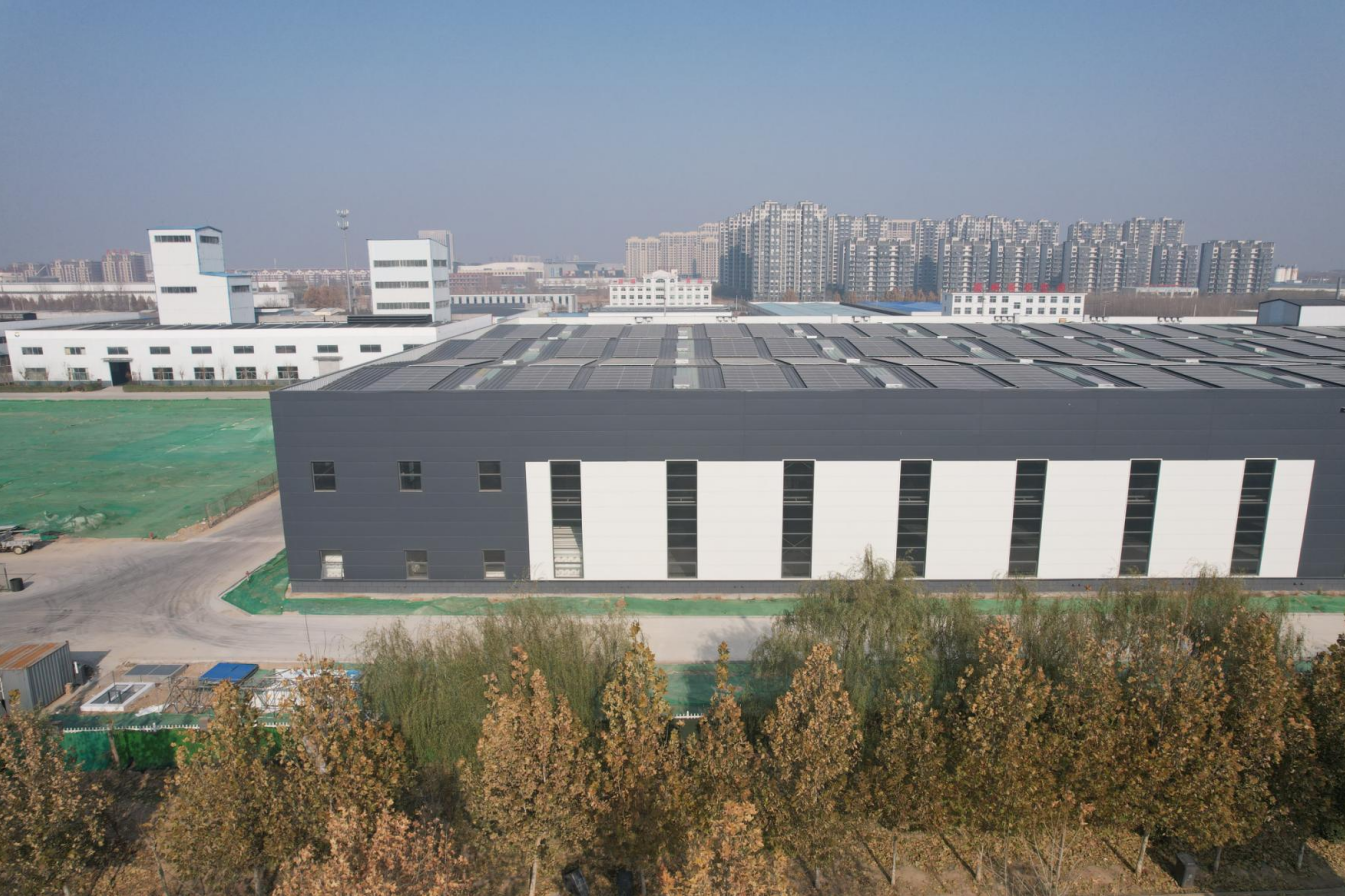
Plan both layers as one schedule, because they are installed as one system and a single late component holds the whole installation. Haoyang Environment Co., Ltd. operates a 200,000 m² manufacturing facility with an annual production capacity of 33,000 tons, a workforce of approximately 190 employees and an R&D team of 20 professional engineers, and reports a six-metre-wide composite drainage network production line — a width relevant to reducing seam count on large containment areas. Export business accounts for 60% of total sales, with major markets in Africa, Central Asia, the Middle East, Southeast Asia and Indonesia, so lead time should be planned against both production and shipping schedules. Buyers can request a quotation and product datasheets through Haoyang Environment Co., Ltd. or review the drainage geonet product page for the current specification set.
Conclusion: Two Duties, One System, Two Specifications
The geomembrane and the drainage geonet are not competing options. The geomembrane is the barrier that prevents liquid leakage; the drainage geonet is the layer that conveys liquid, carries compressive load and must retain its strength in a chemically aggressive environment. In a 24/7 metal smelting containment system, the practical difference between a robust installation and a vulnerable one is usually not which material was chosen — it is whether each layer was specified against its own duty, with its own test basis, in its own line item.
The specification work is therefore straightforward but not optional: fix the geomembrane thickness and durability indicators, fix the geonet thickness, mass and compression point, confirm the chemical exposure case against the ≥90% strength retention figure, and state the acceptance basis before delivery. Everything else — cost, lead time, sample approval — follows from those decisions.
Haoyang Environment Co., Ltd. supplies drainage geonet and geomembrane as matched components for metal smelting anti-seepage systems, with customizable thickness, mass per unit area and polymer selection.
Email: 15315800874@163.com | Tel: +86 15315800874 | WhatsApp: +86 15315800874
Request a Sample or Quotation
Have Questions or Need More Details?
Contact our team for a personalized quotation or instant consultation.
Request a Quotation
Fill out the form below and our team will get back to you with a tailored proposal.
WhatsApp Direct Chat
Prefer to chat in real-time? Message us on WhatsApp for instant assistance & quick answers.
- Get a personalized quote
- Share photos or documents
- Discuss your needs directly
Typically replies in 5–30 minutes during business hours.