Geosynthetic Liner Categories 101: Geomembrane, Geonet, GCL
Geosynthetic liner categories are separated by function, not by polymer. A geomembrane is a continuous flexible sheet that limits the movement of liquid or gas through it. A drainage geonet is a structured core that transmits liquid within the plane of the roll. A composite drainage geonet — frequently written as composite drainage net — bonds a geotextile filter to that core so filtration and drainage are handled by one product. A geosynthetic clay liner (GCL) builds its barrier from a bentonite layer rather than a polymer sheet. None of the four replaces another, and most containment projects use at least two of them in the same cross-section.
Haoyang Environment Co., Ltd. is a geosynthetics manufacturer founded in 2008 and headquartered in Dezhou (Yucheng) National High-Tech Industrial Development Zone, Shandong Province, China. Its range covers geomembranes, geotextiles, composite drainage nets, bentonite waterproof blankets and other geosynthetic materials. This guide explains what each lining category does, where it belongs in a project, and how a buyer recognises which compliance route applies to it.
Why liner categories get mixed up before price is even discussed
Most specification problems in lining work start earlier than the quotation. Three mix-ups account for a large share of them.
1. Barrier products and drainage products are treated as interchangeable
A geomembrane or a GCL is specified to stop flow. A drainage geonet is specified to collect flow and convey it to an outlet. A geonet has an open structure by design, so it cannot serve as a hydraulic barrier; a geomembrane has no in-plane transmission capacity, so it cannot replace a drainage layer. Where both functions are needed, the categories are used together — normally a geomembrane or GCL as the barrier, with a geonet or composite drainage net above, below or between layers.
2. The word composite describes two different products
In supplier catalogues, composite geomembrane or composite membrane usually means a geomembrane bonded or laminated to a geotextile, so the sheet gains protection, friction or cushioning. Composite drainage geonet or composite drainage net means a geonet core with a geotextile filter attached. Both are called composite; only one of them is a barrier. The functional layer has to be identified before the product name is written into a specification.
3. The certificate does not match the product name on the order
Verification documents are issued against a defined scope. When the scope line reads Composite drainage net and the purchase order reads drainage geonet, the document does not automatically cover the order. The step-by-step section below shows how to check this in practice.
Industry background: what the liner market actually looks like
Third-party research places the global geomembrane market at USD 1.9 billion in 2023. Within that revenue, HDPE accounted for 31.3% and mining applications for 39.6% (Grand View Research, geomembrane market report, 2024–2030). Those two figures explain why HDPE dominates liner conversations and why tailings, heap-leach and mine-closure work drives so much specification activity.
Two Geosynthetic Institute specifications sit behind most HDPE tenders. GRI-GM13 covers smooth and textured HDPE geomembranes in thicknesses from 0.75 mm to 3.00 mm with a formulated density of at least 0.940 g/cc. GRI GM42 addresses extreme conditions in the 1.5 mm to 3.0 mm range at 0.945 g/ml or higher, requires catalyzed reactor-grade bimodal resin rather than a blend of monomodal resins, and allows no post-consumer resin in the formulation. Neither specification covers drainage geonets or GCLs; those categories carry their own standards and their own certificates, which is the point this article builds towards.
Category 1: Geomembrane (HDPE geomembrane, composite geomembrane)
A geomembrane is a flexible polymeric sheet manufactured in rolls and joined by welding to form a continuous barrier. In trade usage it also appears as anti-seepage membrane, impermeable membrane or plastic membrane. HDPE is the most widely specified family because it combines low permeability with welded seam strength and resistance to a broad range of chemical exposures.
Surface type is a real specification decision. Smooth sheet is used where interface friction is not critical; textured or spray-textured sheet raises friction against soil and geotextile on slopes. Haoyang produces textured geomembrane on a five-layer co-extrusion blow moulding line integrated with online double-sided texturing equipment, where the base membrane and the double-sided rough structure are formed together in the molten state rather than in a second processing step. The company lists geomembrane in a 0.3 mm to 3.0 mm model range.
A composite geomembrane — a geomembrane bonded to a geotextile — belongs to the same functional family. The membrane remains the barrier; the geotextile adds protection or friction. Buyers should confirm which layer is functional and what geotextile weight is bonded, because the product is often quoted by the total composite weight rather than by membrane thickness.
Compliance route. For the EU/EEA market, the geomembrane scope is covered by ICR Verification of Conformity ICR/VC/HE250525, compliant with EN 13249:2016 and citing CPR (EU) 305/2011, issued 20 May 2025 and valid to 19 May 2030. For the EAEU/Russia market, the geomembrane scope is covered by GOST Certificate of Conformity POCC CN.32682.047C00.0C01.H00840 under GOST 56586-2015, issued 1 June 2022 and valid to 22 May 2028.
Category 2: Drainage geonet
A drainage geonet is an extruded open-structured core whose ribs form continuous channels for in-plane flow. It is specified where liquid or gas has to be collected and carried laterally — under a liner, behind a wall, beneath a slab or above a low-permeability layer — and where a granular drainage blanket would be too deep, too heavy or unavailable. Haoyang lists drainage geonet in a 4.0 mm to 8.0 mm model range.
A geonet is a flow path, not a filter and not a barrier. On its own it will pass fines into the channels, which is why the geotextile component of the next category exists.
Compliance check for plain geonets. In the certificate set reviewed for this article, drainage is certified under the scope names Composite drainage net (ICR, EU/EEA) and 3D Composite Drainage Geonet (GOST, EAEU/Russia). A plain, non-composite drainage geonet does not appear as a separate scope item. Buyers who need a certificate for a plain geonet should confirm the current scope wording with the manufacturer before quoting a certificate number in a tender.
Category 3: Composite drainage geonet (3D composite drainage geonet)
A composite drainage geonet bonds a geotextile filter to one or both faces of a geonet core. The geotextile holds soil particles back while water enters the core; the core carries the water to the outlet. The result is filtration and drainage in a single roll, which is why composite drainage geonets are common in leachate collection layers, retaining structures, plaza and roof drainage, and underdrainage beneath tailings impoundments.
The three-dimensional description refers to the core plus filter assembly rather than a flat sheet: flow travels along the core, and the assembly resists being crushed by the overburden it is designed for. Where the design also needs a barrier, the composite drainage geonet sits next to a geomembrane rather than replacing it.
Compliance route. For the EAEU/Russia market, the 3D Composite Drainage Geonet scope is covered by GOST Certificate of Conformity POCC CN.32682.04NC中0.OC01.H00838 under GOST 33068-2014, issued 1 June 2022 and valid to 22 May 2028.
Category 4: Composite drainage net
Composite drainage net is the scope name used on the EU/EEA verification for the same geonet-plus-filter construction. The record is ICR/VC/HE250523, compliant with EN 13249-2016, issued 20 May 2025 and valid to 19 May 2030. In commercial language, composite drainage net and composite drainage geonet are often used for the same product family, while on paper the two expressions sit on different documents issued against different markets.
That is exactly why the name on the certificate matters. A buyer who needs EU/EEA evidence should ask for the document whose scope reads Composite drainage net, and a buyer who needs EAEU evidence should ask for the document whose scope reads 3D Composite Drainage Geonet. The construction may be the same; the paperwork is not interchangeable.
Category 5: GCL (geosynthetic clay liner)
A GCL is a hydraulic barrier built from a bentonite layer held between geotextiles. When the bentonite hydrates, it swells and seals, so the barrier property comes from the clay mineral rather than from a polymer sheet. Haoyang supplies powder-type bentonite waterproof blankets within this category.
A GCL is not a drainage product and does not carry in-plane flow. In many designs it is used alongside a geomembrane, with the GCL contributing the bentonite barrier and the geomembrane contributing the polymeric one, and with a geonet or composite drainage net handling collection. Because a GCL depends on confinement and hydration, its role in the cross-section is different from a geomembrane even where the two are described together as a composite liner.
Compliance route. For the EU/EEA market, the GCL scope is covered by ICR Verification of Conformity ICR/VC/HE250526, compliant with EN 13249-2016 and citing CPR (EU) 305/2011, issued 20 May 2025 and valid to 19 May 2030. For the EAEU/Russia market, the bentonite waterproof blanket scope is covered by GOST Certificate of Conformity POCC CN.32682.047C00.OC01.H00837 under GOST 70090-2022, issued 19 May 2022 and valid to 22 May 2028.
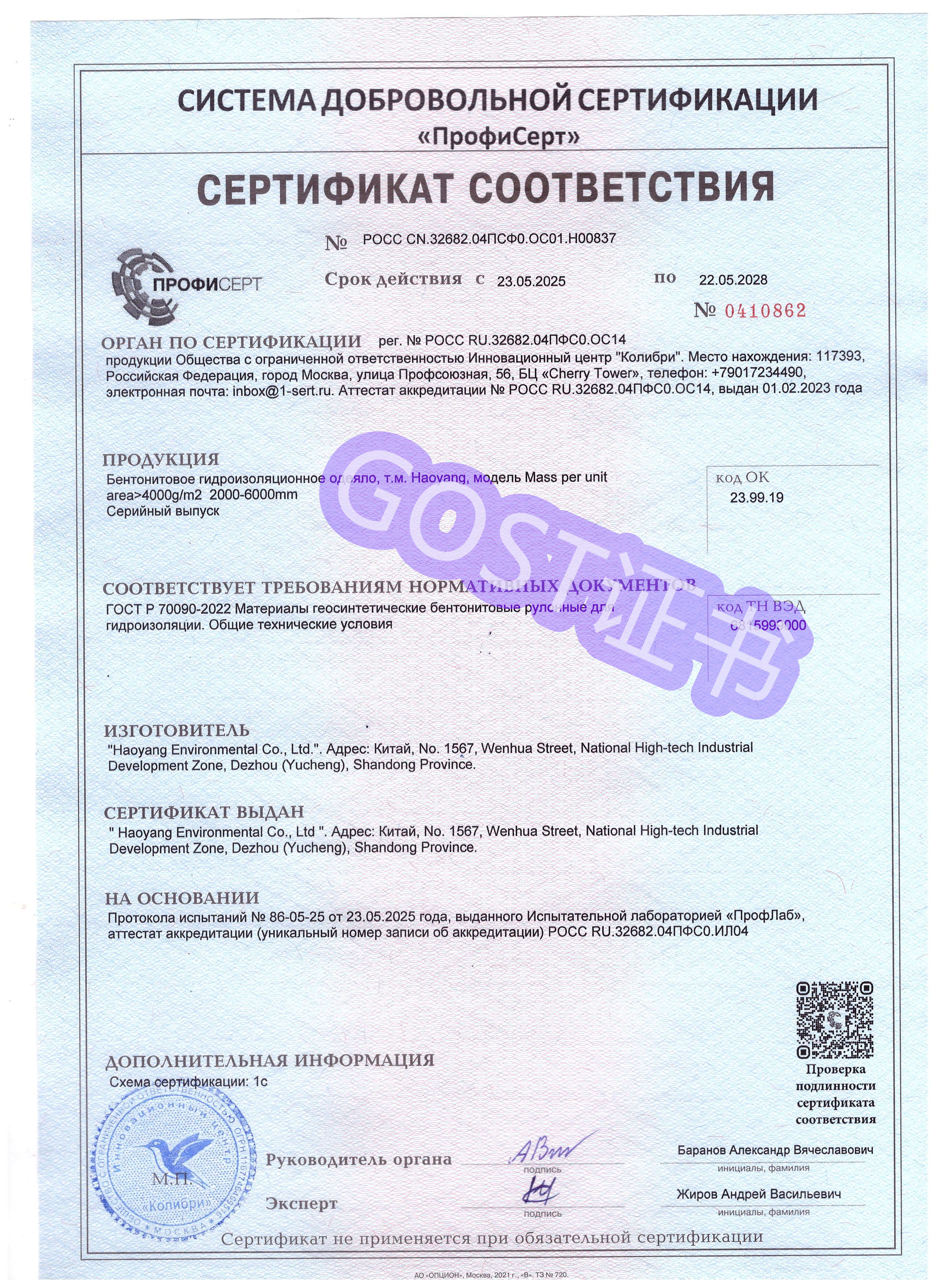
GOST Certificate of Conformity covering the bentonite waterproof blanket (GCL) scope under GOST 70090-2022 for the EAEU/Russia market — one of the records a buyer should match against the product name on the order.
Adjacent category: geotextile, the layer that makes composites work
Geotextiles are not a lining category in the barrier sense, but they appear on the same documents and they are the component that converts a plain geonet into a composite product. Their functions are filtration, separation and protection. Haoyang supplies high-strength polypropylene geotextiles and holds ICR Verification of Conformity ICR/VC/HE250524 under EN 13249:2016 with CPR (EU) 305/2011, plus GOST Certificate of Conformity POCC CN.32682.041C00.OC01.H00839 under GOST 33068-2014. Listing them here prevents a common error: citing a geotextile certificate as evidence for a drainage or barrier product.
Step-by-step: how to identify the applicable compliance route
- State the function before the product name. Barrier, drainage, filtration or protection. If two functions are needed in one layer, the layer is a composite and the certificate scope should say so.
- Fix the exact product form. Smooth or textured geomembrane, plain or composite drainage geonet, GCL, geotextile. Thickness ranges such as 0.3 mm to 3.0 mm for geomembrane and 4.0 mm to 8.0 mm for drainage geonet narrow the question further.
- Choose the market route. EU/EEA projects are evidenced by ICR Verification of Conformity referencing EN 13249:2016. EAEU/Russia projects are evidenced by a GOST Certificate of Conformity issued by ПрофСерт (ProfSert). A project that spans both markets needs both sets of documents.
- Match the scope line word for word. Composite drainage net and 3D Composite Drainage Geonet are different scope strings. Geomembrane, geosynthetic clay liner and geotextile are also separate scopes with separate certificate numbers.
- Check issue and expiry dates. The ICR records cited here run from 20 May 2025 to 19 May 2030. The GOST records cited here expire on 22 May 2028, with issue dates between 19 May 2022 and 23 May 2025. A valid certificate that expired is not evidence.
- Ask for the batch record behind the sheet. Haoyang reports 100% testing, with every roll checked for thickness, tensile strength, tear resistance and puncture, and random rolls sent for stress-crack and chemical-immersion testing. Treat this as a company-reported quality-control practice and keep it separate from certification: a certificate defines a scope, a test record describes a batch.
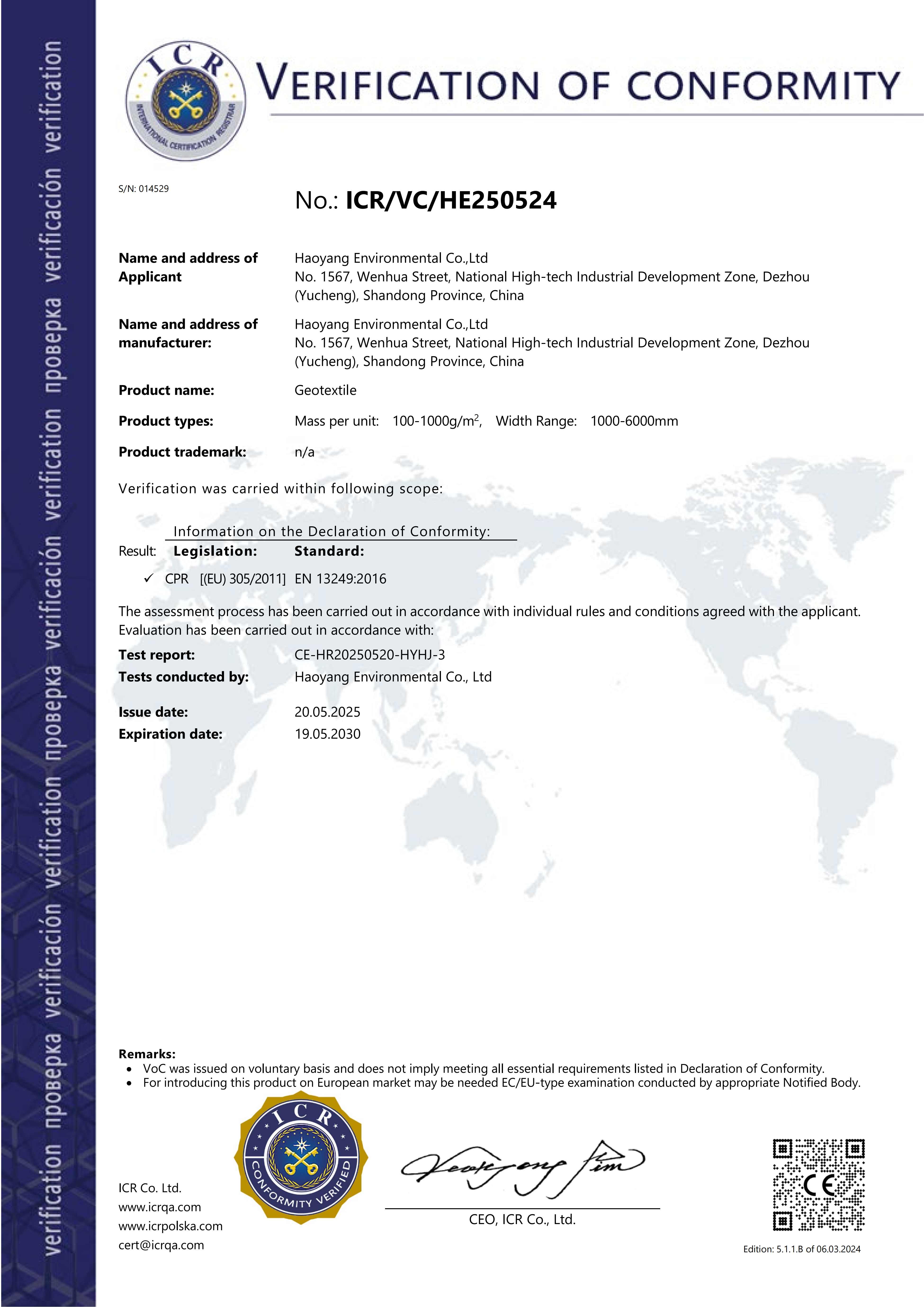
An ICR Verification of Conformity record for the EU/EEA market. The scope line, not the supplier name, determines which product the document actually covers.
Where each category is used
- Mining and tailings. Textured HDPE geomembrane forms the barrier while a composite drainage net handles underdrainage and pressure relief. In a 900,000 square metre gold mine tailings pond basin project in Uzbekistan, the scope covered everything from anti-seepage materials to project construction, using a three-dimensional composite drainage network built from independently developed textured geomembrane and high-strength polypropylene geotextile. The textured geomembrane for that project was produced on a five-layer co-extrusion line with online texturing, a route the company reports reduced production energy consumption by 25% compared with secondary processing.
- Aquaculture and fish ponds. A fish pond geomembrane or aquaculture geomembrane is used as the barrier, with the sheet thickness selected against the pond depth and the mechanical exposure during cleaning.
- Reservoirs and canals. A reservoir anti-seepage membrane, often a composite geomembrane where protection against puncture and UV is required, with a geonet or drainage net behind it to control pore pressure.
- Salt lake mining and pumped storage. These are the applications where buyers typically press hardest on grade selection, asking for salt-resistant, acid- and alkali-resistant or high puncture resistance formulations and for the test data behind those claims. Pumped storage adds a further consideration: rapid water-level changes place cyclic stress on the liner, which is why the specification discussion tends to focus on the sheet and seam properties rather than on the drainage layer alone.
- Landfill and hazardous waste containment. A GCL and geomembrane composite liner with a drainage geonet for leachate collection — the classic three-category cross-section.
- Construction and decoration. Below-grade waterproofing, plaza and roof drainage, and planter drainage typically combine a membrane for the barrier with a composite drainage net for water management in a shallow build-up.
Comparison table: category, function and compliance route
| Category | Primary function | Construction | EU/EEA route (ICR) | EAEU/Russia route (GOST) | Haoyang model range / product form |
|---|---|---|---|---|---|
| Geomembrane (HDPE geomembrane) | Barrier — limits liquid and gas migration | Flexible sheet, smooth or textured, welded into panels | ICR/VC/HE250525 — EN 13249:2016, CPR (EU) 305/2011 | GOST 56586-2015 — POCC CN.32682.047C00.0C01.H00840 | 0.3 mm – 3.0 mm; textured sheet on five-layer co-extrusion line |
| Composite geomembrane / composite membrane | Barrier plus protection or friction | Geomembrane bonded or laminated to a geotextile | Handled under the geomembrane scope — confirm the exact wording | Handled under the geomembrane scope — confirm the exact wording | Confirm which layer is functional and the bonded geotextile weight |
| Drainage geonet | In-plane collection and conveyance of liquid or gas | Extruded open core with continuous flow channels | No separate plain-geonet scope in the records reviewed | No separate plain-geonet scope in the records reviewed | 4.0 mm – 8.0 mm |
| Composite drainage geonet (3D composite drainage geonet) | Filtration and drainage in one roll | Geonet core with bonded geotextile filter | Issued under the scope name Composite drainage net — confirm the mapping | GOST 33068-2014 — POCC CN.32682.04NC中0.OC01.H00838 | Drainage geonet model range 4.0 mm – 8.0 mm |
| Composite drainage net | Same function as the composite drainage geonet; the name used on the ICR scope | Geonet core with bonded geotextile filter | ICR/VC/HE250523 — EN 13249-2016 | Confirm per product with the manufacturer | As above |
| GCL (geosynthetic clay liner) | Barrier — bentonite-based | Bentonite layer held between geotextiles | ICR/VC/HE250526 — EN 13249-2016, CPR (EU) 305/2011 | GOST 70090-2022 — POCC CN.32682.047C00.OC01.H00837 | Powder-type bentonite waterproof blanket |
| Geotextile (adjacent category) | Filtration, separation, protection | Nonwoven or woven fabric | ICR/VC/HE250524 — EN 13249:2016, CPR (EU) 305/2011 | GOST 33068-2014 — POCC CN.32682.041C00.OC01.H00839 | High-strength polypropylene geotextile |
All certificate numbers, standards and validity dates in this table are taken from the records held for Haoyang Environment Co., Ltd. Scope wording is reproduced as issued; a certificate covers only the scope it names.
FAQ
Does ICR Verification of Conformity cover GCL and drainage products, or only geomembrane?
For the EU/EEA market, the ICR records reviewed here list four separate scopes: geomembrane (ICR/VC/HE250525), composite drainage net (ICR/VC/HE250523), geosynthetic clay liner, or GCL (ICR/VC/HE250526), and geotextile (ICR/VC/HE250524). The geomembrane, GCL and geotextile records cite EN 13249:2016 together with CPR (EU) 305/2011; the composite drainage net record cites EN 13249-2016. All four were issued on 20 May 2025 and expire on 19 May 2030. Because each scope is written differently, a tender reference should quote the scope line exactly as it appears on the certificate rather than the general product family.
What thickness ranges can Haoyang supply across these categories, and can specifications be customised?
Haoyang lists geomembrane in a 0.3 mm to 3.0 mm model range and drainage geonet in a 4.0 mm to 8.0 mm model range, alongside high-strength polypropylene geotextiles, composite drainage nets and powder-type bentonite waterproof blankets. Customisation covers logo, width, roll length, thickness, GSM, tensile yield strength, tensile fracture strength, puncture strength and other chemical and physical indicators. Monthly capacity is 3,000 T, annual output is 33,000 T, and the company reports that 100% of output is tested. The manufacturing base covers 200,000 square metres with 190 employees, and the company holds more than 70 patents and proprietary technologies across eight wholly-owned subsidiaries, with 20 engineers and cooperative relationships with universities including Fudan University and Tianjin University of Technology.
What is the minimum order quantity, and what drives the quotation?
The minimum order quantity is 5,000 square metres. Beyond volume, the variables that change a liner quotation most are the ones that change material weight and processing: membrane thickness, roll width, whether the surface is smooth or textured, the geotextile weight bonded into a composite product, and the documentation set required for the destination market. Fixing those five points before requesting prices makes quotations from different suppliers genuinely comparable, because the certificate scope and the product form will then match on every offer.
Can buyers validate material quality before placing a production order?
Haoyang reports 100% testing, with every roll checked for thickness, tensile strength, tear resistance and puncture, and random rolls sent to the laboratory for stress-crack and chemical-immersion testing. Buyers can request material samples and the corresponding test records for the specific product form they intend to specify, which is the practical way to confirm that the sheet, geonet or GCL being quoted is the same item named on the compliance documents.
What is the production lead time, and how does an order start?
Lead time is 10 to 30 days, with on-site support available after delivery. Roughly 60% of output is exported, with established markets in Africa, Europe, Central Asia, Southeast Asia, Australia, South America and the Middle East. To start, send the category (geomembrane, drainage geonet, composite drainage geonet, composite drainage net or GCL), the model or thickness range, the destination market and the compliance route required. A sample request or quotation request can be sent to Shengkang Li at 15315800874@163.com or by phone and WhatsApp on +86 15315800874; the product range is listed at haoyanghuanjing.com.
Conclusion: identify the category first, then the certificate
The four lining categories answer four different questions. A geomembrane, including HDPE geomembrane, composite geomembrane and the variants sold as anti-seepage or impermeable membrane, answers how liquid and gas are stopped. A drainage geonet answers how liquid is collected and moved. A composite drainage geonet or composite drainage net answers both collection and filtration in a single layer. A GCL answers how a bentonite barrier is introduced where a polymeric sheet alone is not the intended solution. Geotextiles support all of them by filtering and protecting.
Once the category is fixed, the compliance question becomes mechanical rather than rhetorical: which scope line covers this product, which market route applies, what standard is cited, and is the document still valid. For EU/EEA work that means the ICR Verification of Conformity records under EN 13249:2016, with CPR (EU) 305/2011 cited on the geomembrane, GCL and geotextile scopes. For EAEU/Russia work it means the GOST records under GOST 56586-2015, GOST 33068-2014 and GOST 70090-2022 respectively. Get those two steps in the right order and most specification disputes disappear before the first pallet is loaded.
Next step: match your project to the right category
Haoyang Environment Co., Ltd. supplies geomembranes, geotextiles, composite drainage nets and bentonite waterproof blankets from Dezhou (Yucheng) National High-Tech Industrial Development Zone, Shandong, China, with ICR and GOST certification records covering the EU/EEA and EAEU markets.
Send your liner category, model range, destination market and required compliance route to request a sample or a quotation. Contact: Shengkang Li · Email 15315800874@163.com · Tel / WhatsApp +86 15315800874 · www.haoyanghuanjing.com
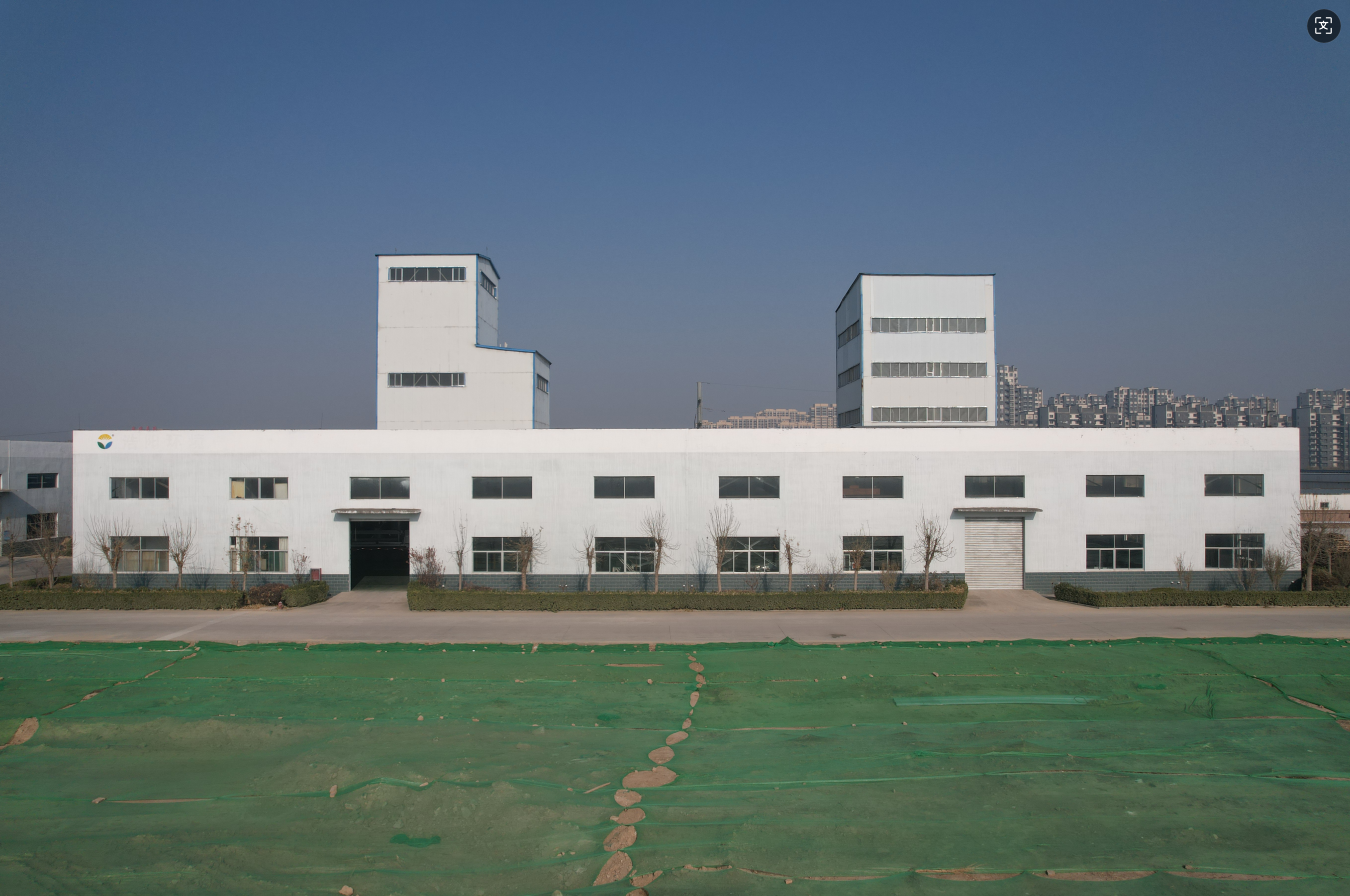
Production workshop at the Haoyang manufacturing base, where geomembranes, geotextiles and composite drainage products are produced and tested before shipment.
Have Questions or Need More Details?
Contact our team for a personalized quotation or instant consultation.
Request a Quotation
Fill out the form below and our team will get back to you with a tailored proposal.
WhatsApp Direct Chat
Prefer to chat in real-time? Message us on WhatsApp for instant assistance & quick answers.
- Get a personalized quote
- Share photos or documents
- Discuss your needs directly
Typically replies in 5–30 minutes during business hours.