Drainage Geonet FAQ: Composite, 3D and High-Compressive Types
A drainage geonet does not seal anything. It creates a controlled path for water and gas so that the geomembrane next to it can keep sealing. That division of labour is the fastest way to understand why composite, 3D composite, acid and alkali resistant, high compressive resistance and high drainage capacity drainage geonets are not interchangeable: each variant answers a different loading, chemical or hydraulic question inside an anti-seepage system that runs 24/7.
This FAQ is written for construction and decoration teams comparing drainage geonet options for the first time, and for buyers who have to explain the choice to an engineer or a client. The product figures below are the published values of Haoyang Environment Co., Ltd (Haoyang Geomembrane), a geosynthetics manufacturer founded in 2008 and headquartered in the Dezhou (Yucheng) National High-Tech Industrial Development Zone, Shandong, China.
Why drainage geonet selection causes problems on real projects
Answer first: most trouble in lined systems is not a liner problem, it is a drainage problem. The geonet compresses under cover, the void channel closes, and water stacks up against the membrane from behind.
Three different conversations get mixed together the moment a buyer asks for a drainage geonet:
- Structure. Is the product a bare geonet core, a core bonded to one geotextile, or a core bonded to two?
- Environment. Will it sit in leachate, tailings pore water, saline groundwater, or aquaculture water that must stay non-toxic and fish-friendly?
- Mechanics. How much load will press the core flat, and how much flow has to pass through it at that load?
Answering only one of the three is how a specification ends up with a product that is chemically correct but hydraulically too weak, or strong enough but needlessly expensive. Published product descriptions for HDPE drainage geonet list landfill, retaining wall, mining, tunnel and civil-engineering applications, and separate bi-planar from tri-planar structures. For construction teams, the translation is practical: the application tells you the load and the chemistry, and those two values choose the grade.
Industry background: why a lining system needs drainage at all
A lining system is a barrier plus a relief path. The geomembrane stops migration; the drainage geonet removes the water, gas and pore pressure that would otherwise load the barrier. In anti-seepage system projects the two products are specified as a pair, and the geonet is the component that protects the membrane from being pushed from behind.
Both application families discussed in this article run continuously. Metal smelting leakage-prevention environments operate on a 24/7 basis, and aquaculture pond anti-seepage systems are described the same way: the water body is held permanently, so the drainage layer never gets a rest period.
Market context is a secondary signal rather than a design input. A 2025 commercial research report on geonet drainage composites sized the global category at about USD 762 million in 2025, rising to roughly USD 1,138 million by 2032 at a reported CAGR of 6.0%. That describes category scale. It says nothing about which type suits a specific pond or smelter pad, and it should not be used as a performance claim.
What does a drainage geonet actually do in a 24/7 anti-seepage system?
Its function is to prevent liquid leakage by removing liquid that has already passed the protected surface, and to prevent water seepage from building pressure under a pond liner. In service the geonet sits between the protected medium and the geomembrane, receives flow across its whole area, and transmits it to a collector or outlet.
Because the function is continuous, the real specification question is not whether it can drain, but whether it can still drain at the design load, in this chemistry, for the design life. The five types below answer that question in different ways.
Composite drainage geonet: what does composite actually mean?
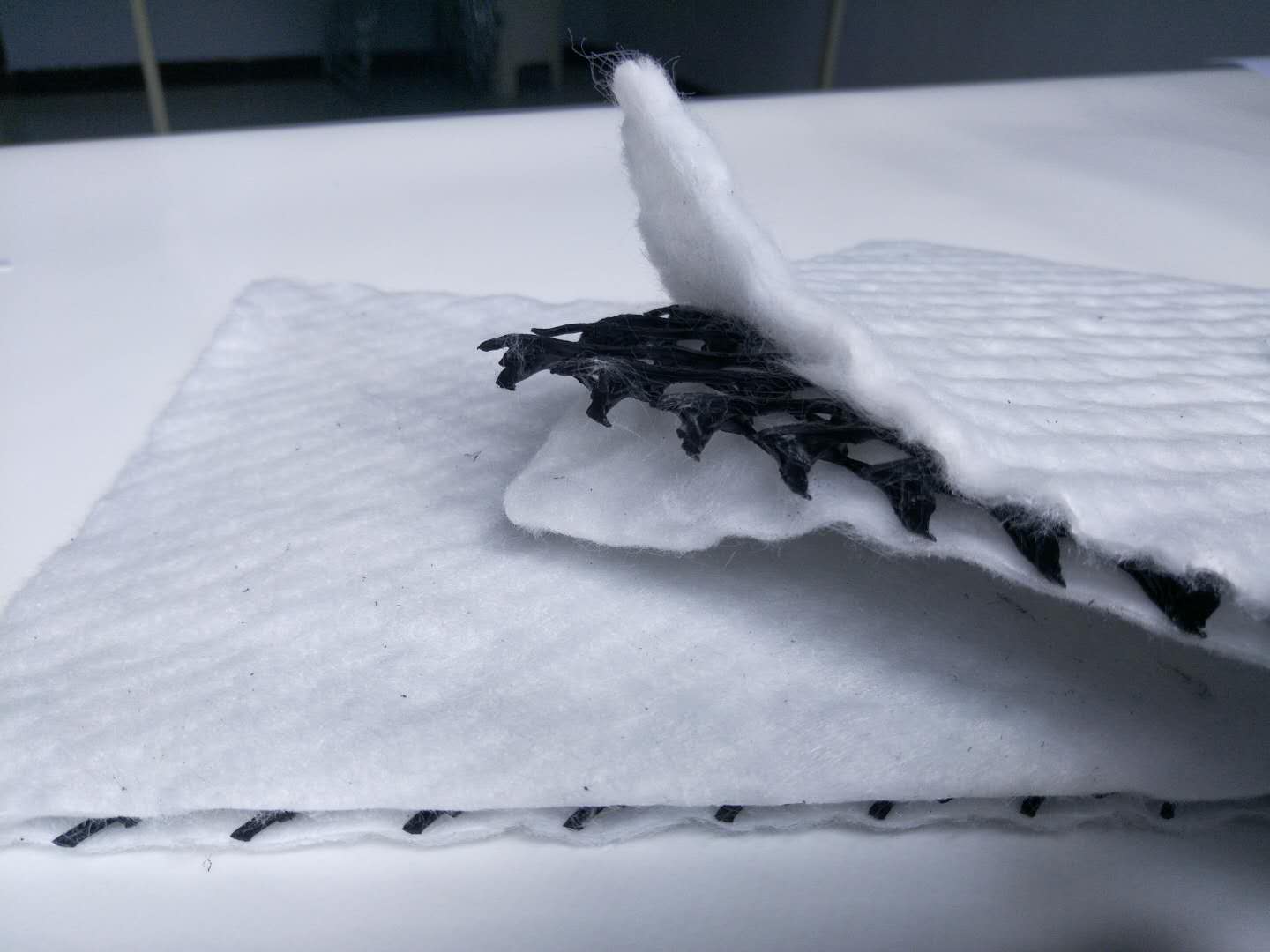
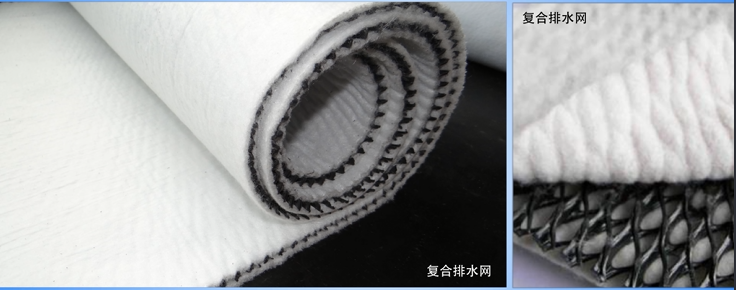
A composite drainage geonet is a geonet core combined with nonwoven geotextile on one or both faces, thermally heat-bonded into a two- or three-layer product. The core transmits flow; the geotextile filters and protects, keeping fines out of the drainage channel so the channel does not silt up.
Material split follows the same logic: the core is normally HDPE and the geotextile is normally PP or PET. That is why the term polyester filament composite drainage geonet and high-strength polypropylene composite drainage geonet describe real configurations rather than marketing phrases — the fibre name refers to the geotextile side of the composite, not to the core.
Haoyang's published drainage geonet range covers:
- thickness: 4.0 mm – 8.0 mm (customizable)
- mass per unit area: 500 – 1400 g/m² (customizable)
- tensile strength (MD/TD): ≥ 5 – 15 kN/m
- elongation at break: 10 – 25%
- compressive strength at 10% strain: ≥ 500 – 830 kPa
- drainage capacity: ≥ 50 – 120 (L/min)/m (customizable)
- materials: HDPE / PP / PET
Design implication: the single-sided versus double-sided decision is a contact question, not a quality question. Double-sided composite is used where soil or granular material touches both faces and filtration is needed on both. Single-sided composite is used where one face sits against a concrete structure or directly against the membrane.
3D composite drainage geonet: where does the third dimension come from?
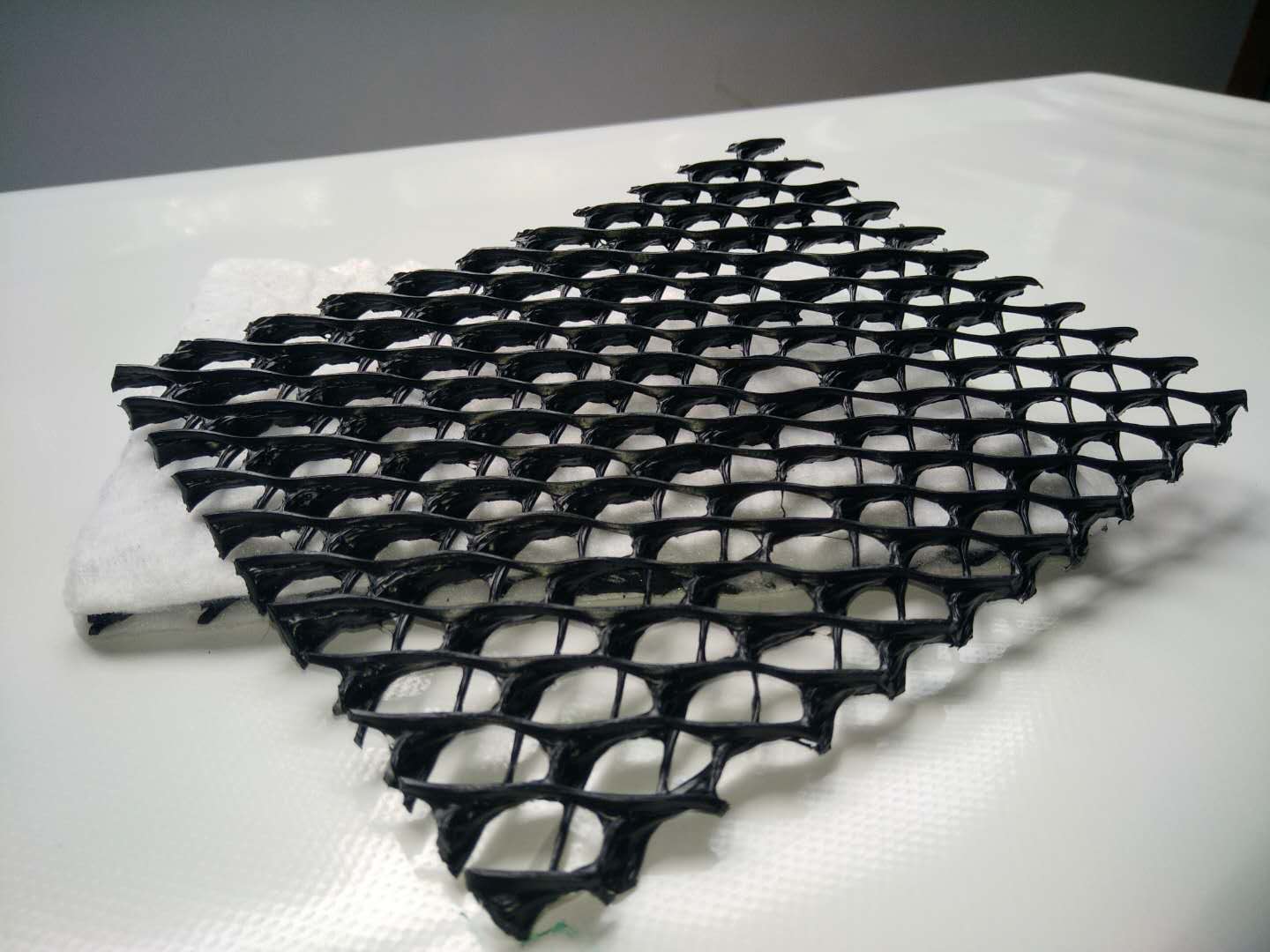
3D refers to the core geometry, not to a third product layer. A three-dimensional core creates void channels in more than one plane, and published industry descriptions distinguish bi-planar from tri-planar forms on exactly that basis. A 3D composite drainage geonet is therefore a three-dimensional core with geotextile bonded to one or both faces.
The practical value of the 3D structure appears where the drainage path has to survive irregular contact and point loading — a tailings basin base, a slope face, or ground with settlement risk. Haoyang's work on the seepage-control project for the tailings pond basin of a gold mine in Uzbekistan used 900,000 m² of material and applied a three-dimensional composite drainage network built from textured geomembrane and high-strength polypropylene geotextile, with the supplier also responsible for on-site installation and construction support.
One caution is worth repeating. The 3D label says nothing about flow or strength on its own. Two three-dimensional products of the same nominal thickness can report very different compressive and drainage values, so the geometry description should always be followed by datasheet numbers measured at the design load.
Acid and alkali resistant drainage geonet: when does chemistry decide the specification?
Chemistry decides the specification when the drainage layer sits in leachate, tailings pore water, smelting residue contact water, or aggressive soil. Haoyang's published acid and alkali resistance for its drainage geonet is ≥ 90% strength retention.
How to read that number. A retention figure without the exposure medium, concentration, duration, temperature and test method is a screening value, not a chemical compatibility approval. For landfill, mining and smelting service, request the underlying test report for the specific resin and the specific exposure chemistry, and confirm UV resistance as a separate property.
The UV point matters for exposed or semi-exposed installation, and it is one of the stated special requirements in metal smelting leakage-prevention applications, alongside high chemical resistance and long service life. A corrosion resistant drainage geonet for an aggressive site is therefore a resin and grade decision, not a coating decision.
High compressive resistance drainage geonet: when does load decide the specification?
Compressive resistance decides the specification whenever the geonet will be buried under significant cover, traffic loading, or structural fill. The reason is mechanical: a geonet drains through its voids, so once the core compresses, the flow area shrinks and the drainage capacity falls with it.
For reference, published industry specification literature describes biplanar geonets in the 4–8 mm thickness range with compressive strength of roughly 500–1,000 kPa and transmissivity in the 10⁻³–10⁻² m²/s range, referenced to ASTM D4716 for transmissivity and ASTM D1621 for compressive behaviour. Haoyang's published compressive strength at 10% strain is ≥ 500–830 kPa.
Read the two statements together and the selection logic becomes clear: a high compressive resistance grade is selected when the calculated load sits at the upper end of the normal range, or when the design cannot tolerate much loss of void at 10% strain. Subgrade, tunnel, slope protection and landfill base applications are the usual places where that calculation drives the order rather than the price.
High drainage capacity geonet: when does flow decide the specification?
Flow decides the specification when the inflow rate is high relative to the drainage path length or width. Haoyang's published drainage capacity is ≥ 50–120 (L/min)/m, with customization available across the range.
Two conditions deserve specific attention. First, capacity must be quoted at the design normal stress, because flow falls as compressive load rises — a capacity figure measured with no load overstates what happens under six metres of cover. Second, the reporting basis matters: the summary figure is published without stated hydraulic gradient, normal stress or specimen configuration, so it should be treated as a screening range and confirmed with a test report before it is written into a tender or a design calculation.
How do these types behave in aquaculture ponds and metal smelting systems?
Answer first: aquaculture selects on non-toxicity and fish safety, while metal smelting selects on chemical resistance and UV durability. Both select on long service life, and both run 24/7.
| System | Role of the drainage geonet | Stated special requirements | System pairing | Typical markets cited |
|---|---|---|---|---|
| Aquaculture pond anti-seepage | Prevent water seepage and relieve pressure under the pond liner | Non-toxic, UV resistant, fish-friendly, long service life | Geomembrane plus drainage geonet | Laos, Cambodia, Indonesia, Vietnam |
| Metal smelting leakage prevention | Prevent liquid leakage and collect seepage from the containment area | High chemical resistance, UV resistance, long service life | Drainage geonet plus geomembrane | Laos, Cambodia, Indonesia, Vietnam, Democratic Republic of the Congo, Republic of the Congo, Russia, Uzbekistan, Kyrgyzstan, Kazakhstan, Australia, Chile |
In both cases the drainage geonet works with a geomembrane rather than instead of one. The full anti-seepage system is a pair: a 0.3 mm – 3.0 mm geomembrane for the barrier and a 4.0 mm – 8.0 mm drainage geonet for relief and collection. Specifying the geonet without the membrane leaves the barrier undefined; specifying the membrane without the geonet leaves the barrier unsupported against pressure.

How to specify and verify a drainage geonet, step by step
The sequence below keeps the type choice tied to project conditions instead of to a catalogue label.
- Fix the barrier first. Decide geomembrane thickness and layout, because the barrier defines where the drainage layer must sit and which face needs filtration.
- Calculate inflow. Estimate the water or leachate volume the layer must remove, then convert it to a required flow per metre at the design gradient.
- Calculate the load. Add cover depth, traffic and structural fill to obtain the normal stress at the geonet, then select a compressive grade that stays above that value at 10% strain.
- Screen the chemistry. Match the resin system to the exposure; for aggressive service, require acid and alkali retention evidence with the test protocol attached, plus separate UV resistance confirmation.
- Choose the structure. Single- or double-sided geotextile, bi-planar or tri-planar core, based on which faces contact soil, structure or membrane.
- Verify certification for the destination market. For EU-facing submittals, Haoyang's drainage geonet certificate reference is ICR/VC/HE250524 and the composite drainage geonet reference is ICR/VC/HE250523, with reference to EN 13249:2016 and CPR (EU) 305/2011. For Russia and the EAEU, GOST certificates cover the 3D composite drainage geonet and the drainage geonet.
- Match the acceptance framework. ASTM D7273/D7273M-08(2026) sets out acceptance testing requirements for geonets and geonet drainage geocomposites, and ASTM D7931/D7931M-21a is a standard guide for specifying drainage geocomposites. Use them to structure the submittal; a standards catalogue entry is not proof that a specific roll complies.
- Confirm manufacturing and logistics. Roll width, roll length, thickness, mass per unit area, tensile values and piercing strength are all customizable; MOQ is 5000 m² and lead time is 10–30 days.
- Approve by sample, then by first delivery. Check the delivered roll against the approved sample before installation begins, and keep the inspection record with the submittal.
Comparison table: five drainage geonet types side by side
The table compares published properties within one manufacturer's drainage geonet range. It is a selection aid, not a third-party ranking.
| Type | What defines it | Published figures in the Haoyang range | Select it when | What to check before ordering |
|---|---|---|---|---|
| Composite drainage geonet | Geonet core bonded to nonwoven geotextile on one or both faces, forming a two- or three-layer product | Thickness 4.0–8.0 mm; mass 500–1400 g/m²; tensile ≥5–15 kN/m; materials HDPE/PP/PET | Soil or granular media contact the product and filtration is required | Which faces need geotextile; single-sided and double-sided change the installation detail |
| 3D composite drainage geonet | Three-dimensional core (bi-planar or tri-planar) with geotextile on one or both faces | Same published range; core geometry is the variable | Irregular contact, settlement risk, tailings basins, slopes | The 3D label alone states no flow or compressive value; read the datasheet at design load |
| Acid and alkali resistant drainage geonet | Grade selected for chemical exposure | Acid and alkali resistance ≥90% strength retention | Leachate, tailings pore water, smelting residues, aggressive soil | Exposure medium, concentration, duration and test method behind the retention figure |
| High compressive resistance drainage geonet | Grade positioned at the upper end of the load range | Compressive strength at 10% strain ≥500–830 kPa; published biplanar industry reference 500–1,000 kPa (ASTM D1621, ASTM D4716) | Deep cover, traffic load, subgrade, tunnel, landfill base | Confirm the delivered grade against the calculated load at 10% strain, not the headline maximum |
| High drainage capacity geonet | Grade positioned for higher flow | Drainage capacity ≥50–120 (L/min)/m, customizable | High inflow, long drainage path, pond drawdown | Capacity must be quoted at the design normal stress and hydraulic gradient |
FAQ: compliance, capability, budget, sample and lead time
Which certificates should a drainage geonet carry for EU or EAEU projects?
For EU-facing submittals, ask for the certificate reference and the standard it is issued against, then check that the reference matches the product grade being supplied. Haoyang's drainage geonet is referenced as ICR/VC/HE250524 and its composite drainage geonet as ICR/VC/HE250523, with EN 13249:2016 and CPR (EU) 305/2011 as the referenced framework. For Russia and the EAEU, GOST certificates cover the 3D composite drainage geonet and the drainage geonet. Certification references support a submittal; they do not replace project-specific test reports or the destination market's own regulatory requirements.
Can one supplier cover composite, 3D and high-load grades in a single order?
Within one product family, yes. Thickness, mass per unit area, roll width, roll length, tensile yield and fracture strength and piercing strength are all customizable, and the same production base reports a monthly capacity of 3000 T with 100% testing. Haoyang operates a composite drainage network production line described as the first domestic six-metre-wide line, which matters when wide rolls reduce the number of seams on site. Company-wide annual output is 33,000 T, and on-site support is available after delivery.
What drives drainage geonet price, and what budget range is realistic?
Price follows thickness, mass per unit area, geotextile configuration, resin system, roll width and order quantity. As an external benchmark, a 2026 supplier-based price survey put standard drainage geonet material at roughly USD 1.60–10.76 per square metre. That band is wide precisely because it mixes very different specifications, so treat it as a sanity check on a quotation rather than as a budget. A comparable quotation has to be issued against your thickness, mass, width, quantity and delivery market.
How do I get a sample before committing to a full order?
Request a sample of the exact specification you intend to buy — same thickness, same mass per unit area, same geotextile configuration — and check it against the datasheet before it is approved. Samples that do not match the intended grade prove nothing. Contact Haoyang directly: Shengkang Li, email 15315800874@163.com, telephone and WhatsApp +86 15315800874, or through the company website at https://www.haoyanghuanjing.com/.
What are the MOQ, lead time and delivery terms?
MOQ is 5000 m² and lead time is 10–30 days. Export markets served include Africa, Europe, Central Asia, Southeast Asia, Australia and South America, with a 60% export share across a marketing network covering more than 70 countries and regions. To move from evaluation to a specification-matched quotation, send five inputs: the application (aquaculture pond, smelting containment, subgrade, tunnel, slope or landfill), required thickness, required mass per unit area, destination market, and the certificate you need to submit.
Conclusion
Composite, 3D composite, acid and alkali resistant, high compressive resistance and high drainage capacity drainage geonets are five answers to three questions: what touches the product, what the product sits in, and what load and flow it must survive. Answer those three and the type choice usually becomes obvious. Skip them, and the label on the roll will not save the system.
For anti-seepage work that runs 24/7 — aquaculture ponds and metal smelting containment in particular — the sequence is consistent: barrier first, flow second, load third, chemistry fourth, certification fifth, and sample approval before shipment.
Next step: send your application, thickness, mass per unit area and destination market to Haoyang Environment Co., Ltd for a specification-matched quotation or a sample of the exact grade. Email 15315800874@163.com, WhatsApp +86 15315800874, or visit https://www.haoyanghuanjing.com/ and https://blog.haoyanghuanjing.com/product/drainage-geonet.html for the drainage geonet product page.
Have Questions or Need More Details?
Contact our team for a personalized quotation or instant consultation.
Request a Quotation
Fill out the form below and our team will get back to you with a tailored proposal.
WhatsApp Direct Chat
Prefer to chat in real-time? Message us on WhatsApp for instant assistance & quick answers.
- Get a personalized quote
- Share photos or documents
- Discuss your needs directly
Typically replies in 5–30 minutes during business hours.