EU/EEA vs EAEU Geomembrane Certification: Which Route Fits Your Project?
EU/EEA vs EAEU Geomembrane Certification: Which Compliance Route Fits Your Project?
Short answer: neither route is universally better. The EU/EEA route fits a project whose tender, owner specification or national requirement points to EN 13249:2016 and expects an ICR Verification of Conformity. The EAEU route fits a project whose documents point to GOST standards and expect GOST certificates of conformity. The real decision sits in the details around the certificate — product scope, validity window, acceptance test and purchasing terms — not in the certificate headline.
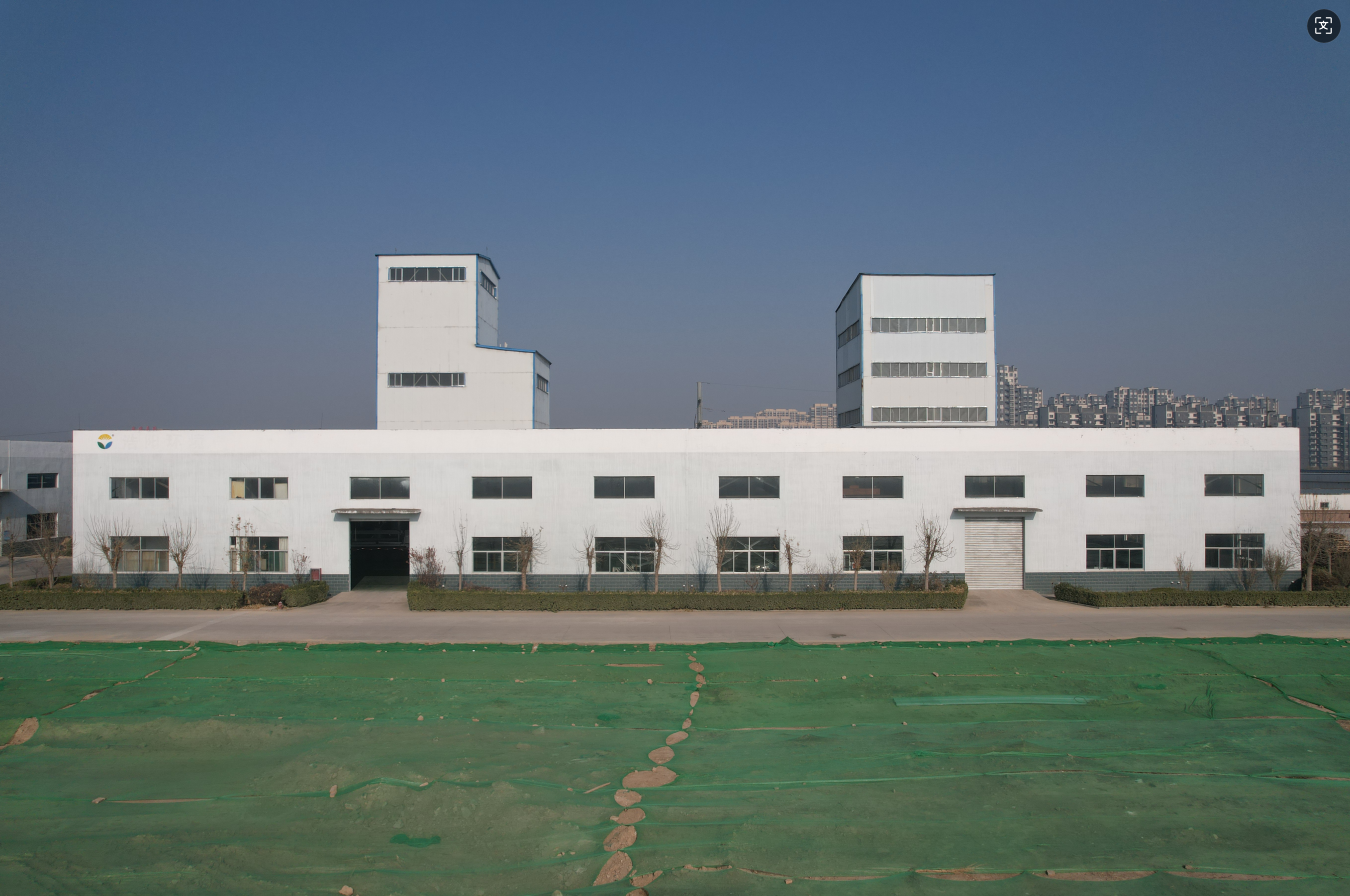
Haoyang Geomembrane is the geomembrane product line of Haoyang Environment Co., Ltd., a geosynthetics manufacturer founded in 2008 and headquartered in the Dezhou (Yucheng) National High-Tech Industrial Development Zone, Shandong Province, China. Haoyang holds conformity documents on both sides of this comparison, which is why the question “which route” can be answered per project rather than per supplier.
The Real Problem: Two Compliance Systems, One Procurement File
Certification disputes on geomembrane projects are rarely about whether the material performs. They are about a document that does not match the file it was placed in. Three failure patterns account for most of these mismatches.
- Scope mismatch. A certificate covering one product is submitted to satisfy a requirement written for another. Haoyang’s EAEU set shows the trap clearly: certificate POCC CN.32682.041C00.OC01.H00839 is issued for geotextile under GOST 33068-2014, while the geomembrane is covered by a separate certificate, POCC CN.32682.047C00.0C01.H00840, under GOST 56586-2015. Same manufacturer, same factory, different scope, different standard. A tender clause naming the geomembrane cannot be closed with the geotextile document.
- Validity window. The certificates in this comparison expire on different dates. The EAEU documents expire on 2028-05-22. The EU/EEA documents associated with this product range expire on 2030-05-19. For a project whose construction and defect-liability period run past those dates, procurement needs a renewal or extension statement before award, not after delivery.
- Authority, standard and jurisdiction pairing. An ICR Verification of Conformity references EN 13249:2016 and is issued for the EU/EEA market. A GOST certificate references a GOST standard and is issued by ПрофСерт (ProfSert) for the EAEU/Russia market. The two documents answer different legal questions and are not interchangeable substitutes in either direction.
The practical consequence is simple: the certification question should be answered by the project’s governing documents first, and by supplier preference second. A supplier holding the “wrong” route for a given tender is not a lower-quality supplier — it is a supplier whose file does not match that specific procurement requirement.
Background: How the Two Frameworks Are Structured
On the EU/EEA side, the conformity file in this comparison is a Verification of Conformity issued by ICR. Four certificates in the set share the same issue date of 2025-05-20 and the same expiry date of 2030-05-19, and each is scoped to a single product family:
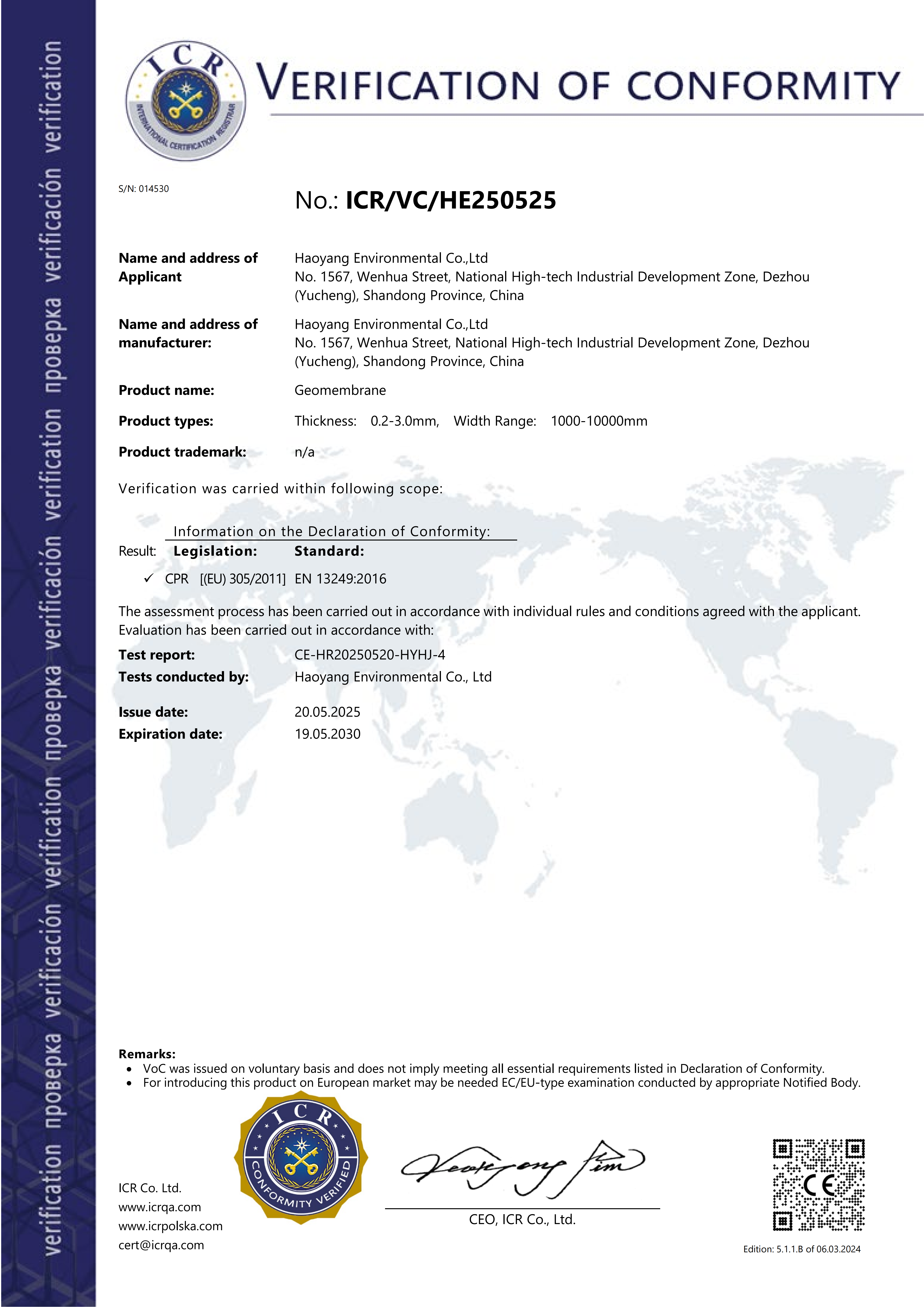
- ICR/VC/HE250525 — Geomembrane, compliant with EN 13249:2016; standard reference EN 13249:2016 and CPR (EU) 305/2011.
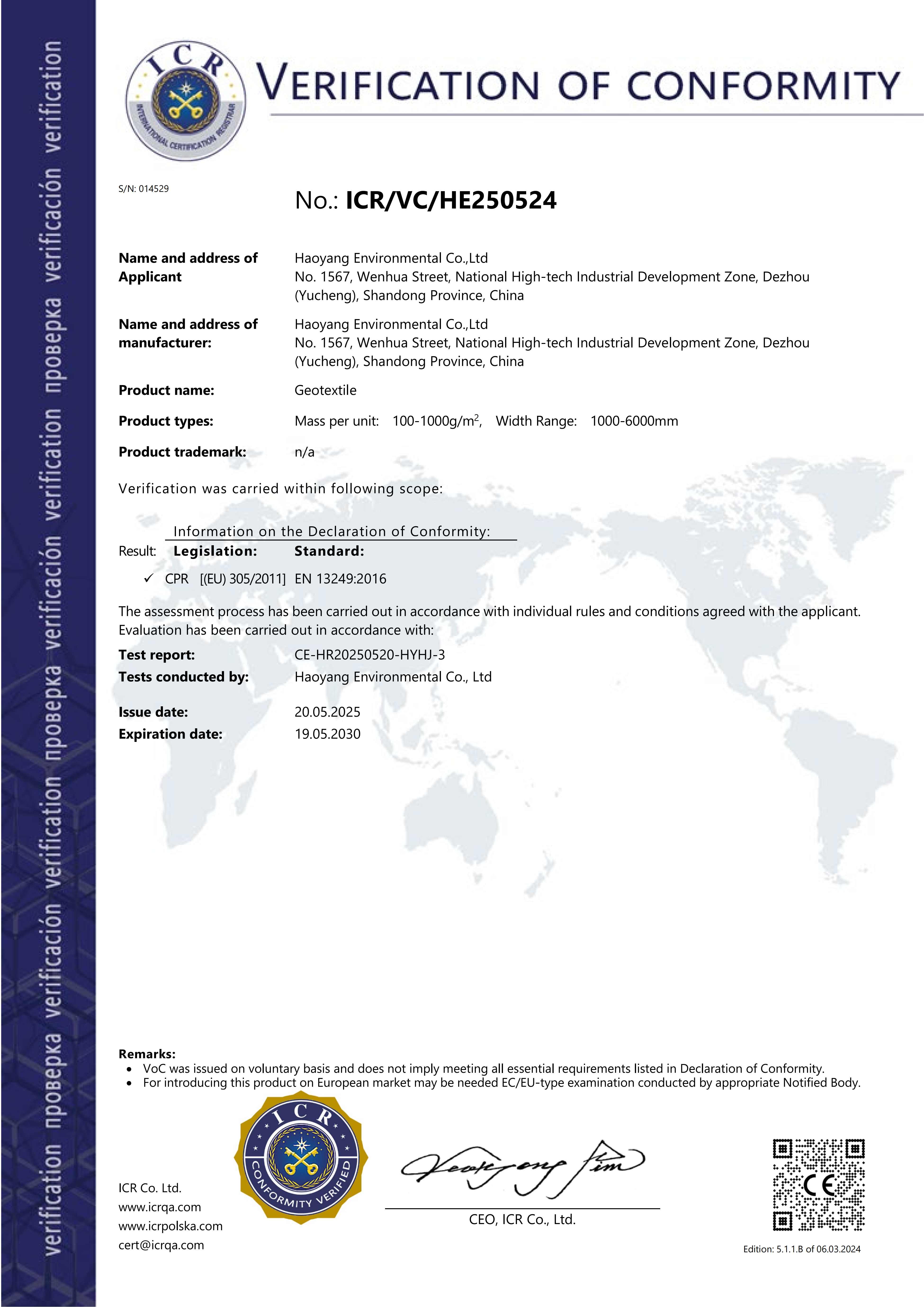
- ICR/VC/HE250524 — Geotextile, compliant with EN 13249:2016; standard reference EN 13249:2016 and CPR (EU) 305/2011.
- ICR/VC/HE250526 — Geosynthetic Clay Liner (GCL), compliant with EN 13249:2016; standard reference EN 13249:2016 and CPR (EU) 305/2011.
- ICR/VC/HE250523 — Composite drainage net, compliant with EN 13249-2016.
On the EAEU/Russia side, conformity is documented per product against a named GOST standard, and each certificate carries its own validity window:
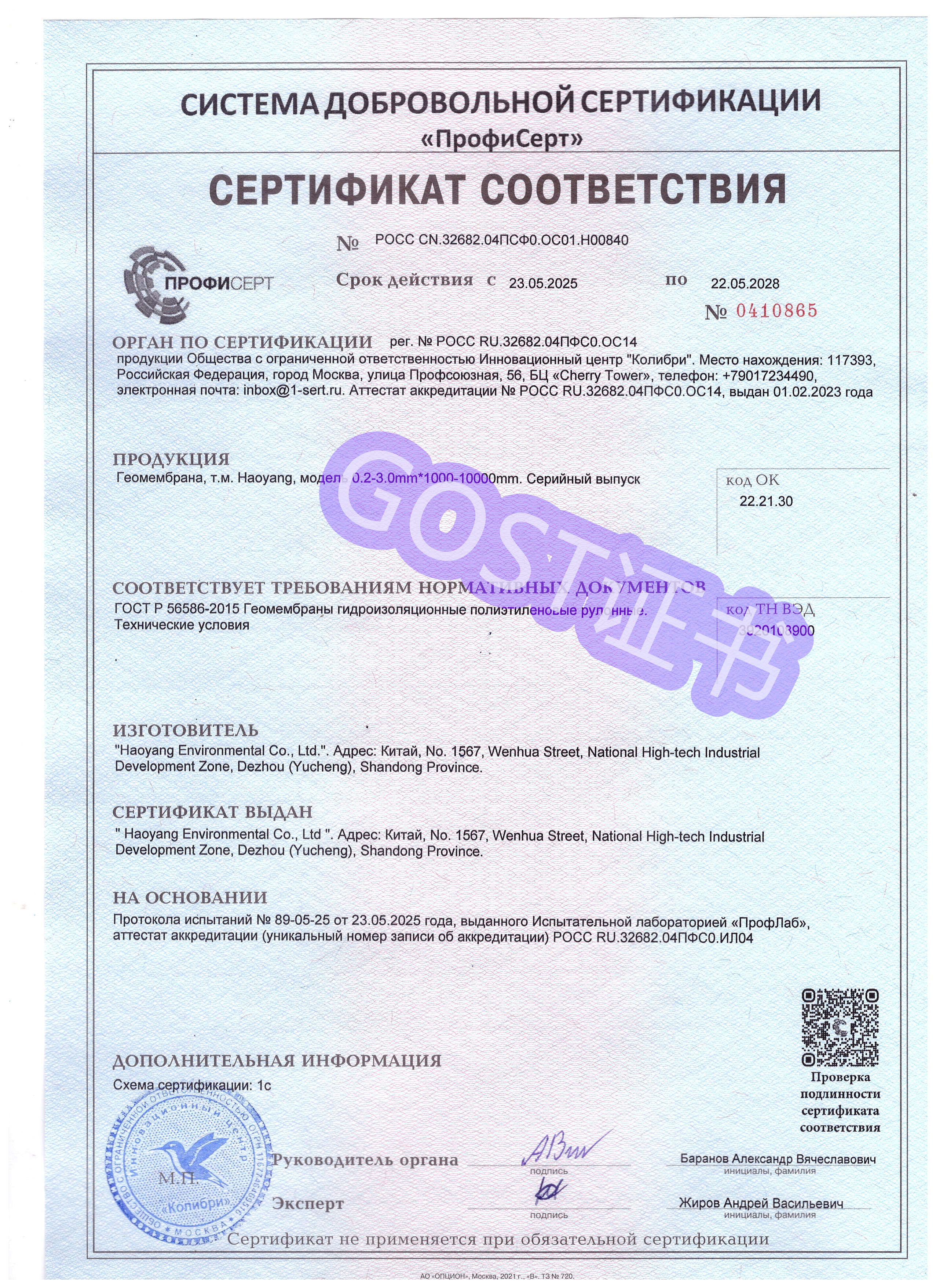
- POCC CN.32682.047C00.0C01.H00840 — Geomembrane, GOST 56586-2015, issued 2022-06-01, valid to 2028-05-22.
- POCC CN.32682.041C00.OC01.H00839 — Geotextile, GOST 33068-2014, issued 2025-05-23, valid to 2028-05-22.
- POCC CN.32682.047C00.OC01.H00837 — Bentonite Waterproof Blanket, GOST 70090-2022, issued 2022-05-19, valid to 2028-05-22.
- A further GOST 33068-2014 certificate in the same set covers the 3D composite drainage geonet.
A second layer of confusion comes from international industry specifications. GRI-GM13 covers smooth and textured HDPE geomembranes in the 0.75–3.00 mm thickness range at a formulated density of at least 0.940 g/cc. GRI GM42 covers HDPE geomembranes of 1.5–3.0 mm at a formulated sheet density of at least 0.945 g/ml for extreme conditions, specified from catalyzed reactor-grade bimodal resin with no post-consumer resin permitted. These are technical benchmarks that buyers and engineers frequently cite in specifications. They are not a statutory conformity route, and quoting them in a tender does not remove the requirement for a jurisdiction-specific certificate.
Market context explains why the question keeps surfacing in procurement rather than in laboratories. The global geomembrane market was valued at USD 1.9 billion in 2023 according to Grand View Research, with the HDPE raw material segment accounting for 31.3% of global revenue in the same year and mining applications accounting for 39.6%. Where mining and large infrastructure procurement dominate, the certification file becomes a gate on the project schedule, not a paperwork afterthought.
Detailed Solution: What Each Route Covers in Practice
The decision is not “which certificate is stronger”. It is “which certificate is scoped to the product, market and period of this project”. The two routes are built differently, and each must be read line by line.
Route A — ICR Verification of Conformity (EU/EEA)
The EU/EEA route in this comparison is organised as one verification per product family, all issued by ICR on 2025-05-20 and valid to 2030-05-19. For a geomembrane package, the operative document is ICR/VC/HE250525, which states geomembrane compliance with EN 13249:2016 and references CPR (EU) 305/2011. Where the package also includes geotextile, GCL or composite drainage net, those items are covered by their own certificates — ICR/VC/HE250524, ICR/VC/HE250526 and ICR/VC/HE250523 respectively — not by the geomembrane certificate.
What this means for a buyer: an EU/EEA submission file is normally a set, not a single page. Reviewers should expect one certificate per product scope, confirm that each names the correct standard reference, and confirm that the issue and expiry dates bracket the project schedule.
Route B — GOST Certificates of Conformity (EAEU/Russia)
The EAEU route is organised per product against a named GOST standard, with each certificate carrying its own validity window and its own issuing date. For geomembrane, the operative document is POCC CN.32682.047C00.0C01.H00840 against GOST 56586-2015, valid to 2028-05-22. Geotextile is documented separately under GOST 33068-2014 in POCC CN.32682.041C00.OC01.H00839, and the bentonite waterproof blanket is documented under GOST 70090-2022 in POCC CN.32682.047C00.OC01.H00837.
What this means for a buyer: the EAEU file is standard-specific. If the tender cites GOST 56586-2015 for the liner, the document to check is the certificate that names GOST 56586-2015 — not a certificate issued under a different GOST number for a different product, even if both belong to the same supplier.
Product-to-Certificate Mapping
| Product scope as written on the certificate | EU/EEA document | EAEU / Russia document |
|---|---|---|
| Geomembrane | ICR/VC/HE250525 (EN 13249:2016, CPR (EU) 305/2011) | POCC CN.32682.047C00.0C01.H00840 (GOST 56586-2015) |
| Geotextile | ICR/VC/HE250524 (EN 13249:2016, CPR (EU) 305/2011) | POCC CN.32682.041C00.OC01.H00839 (GOST 33068-2014) |
| Geosynthetic Clay Liner (GCL) | ICR/VC/HE250526 (EN 13249:2016, CPR (EU) 305/2011) | Not covered by the GOST certificates listed above |
| Composite drainage net / 3D composite drainage geonet | ICR/VC/HE250523 (compliant with EN 13249-2016) | Covered under a separate GOST 33068-2014 certificate |
| Bentonite Waterproof Blanket | Not covered by the ICR certificates listed above | POCC CN.32682.047C00.OC01.H00837 (GOST 70090-2022) |
Step-by-Step: Selecting the Route in Six Steps
The sequence below can be applied to any geomembrane package, whether the liner is a fish pond geomembrane, a tailings pond geomembrane or a reservoir anti-seepage membrane, because the logic follows the procurement file rather than the application.
- Read the jurisdiction from the governing documents. The country of installation, the owner’s specification and any lender or insurer requirement define the route. A supplier cannot switch the route by preference, and a project cannot switch it by convenience.
- List the products and parameters the package must cover. For Haoyang, HDPE geomembrane is offered in the 0.3 mm to 3.0 mm range and drainage geonet in the 4.0 mm to 8.0 mm range. Each item on that list needs its own certificate scope line.
- Map each product to a certificate, line by line. Match the scope wording on the certificate, the standard number, and the issuing authority. Do not accept a geotextile certificate as evidence for a geomembrane clause.
- Check the validity window against the programme. The EAEU documents in this set expire on 2028-05-22; the EU/EEA documents expire on 2030-05-19. If construction, commissioning or the defect-liability period extends beyond the expiry date, request a renewal plan in writing before award.
- Align acceptance criteria and inspection documents. Pre-Shipment test is the stated acceptance criterion, and production is described as 100% tested. Roll-level testing is reported for thickness, tensile strength, tear resistance and puncture, with random rolls taken for stress-crack and chemical-immersion testing. Buyers should confirm that the inspection plan they sign matches the certificate scope they are relying on.
- Lock the commercial terms. The minimum order quantity is 5,000 ㎡, delivery terms are FOB or CIF, payment terms are 30/70 or 100, and typical production lead time is 10 to 30 days. These terms should be fixed in the same document as the certification requirement, so that a late certificate change does not reopen pricing.
Use Cases: Three Project Profiles
Profile 1 — Mining tailings project inside the EAEU
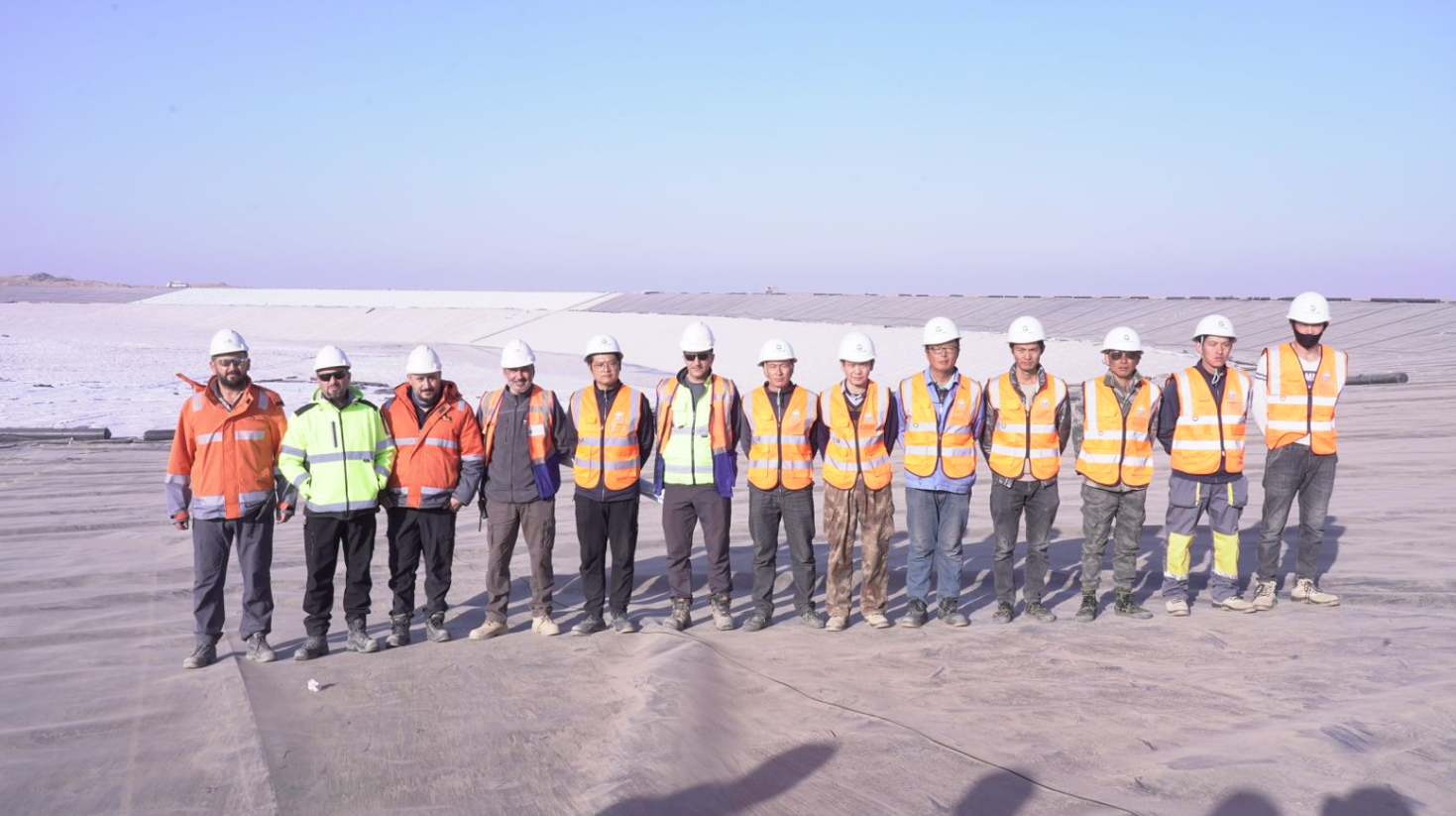
A tailings pond geomembrane package tendered under GOST 56586-2015 is closed with POCC CN.32682.047C00.0C01.H00840. The mining segment accounts for 39.6% of global geomembrane revenue in 2023, which means procurement teams in this segment meet the standard-specific file requirement most often. Where the same package also specifies a geotextile component, POCC CN.32682.041C00.OC01.H00839 is the corresponding document. Haoyang’s mining and smelting engineering experience includes a 900,000 square meter tailings pond basin seepage control project for a gold mine in Uzbekistan, delivered as a full-chain service from material supply to on-site installation and construction, using a composite system of textured geomembrane and high-strength polypropylene geotextile.
Profile 2 — Reservoir or hydraulic project inside the EU/EEA
A reservoir anti-seepage membrane or pumped storage lining package tendered against EN 13249:2016 is closed with ICR/VC/HE250525 for the geomembrane, plus the matching ICR certificate for geotextile, GCL or composite drainage net where those products are included. Liners in pumped storage facilities are subject to stress from rapid water level changes, and geomembranes are used to mitigate that stress compared with traditional materials — which is a design consideration that runs alongside, not instead of, the conformity file.
Profile 3 — Dual-market tender or framework agreement
A contractor bidding into both EU/EEA and EAEU markets, or a distributor serving both, can be served from one production base because both certificate families exist in the same manufacturer’s portfolio. In that case the procurement file carries the two sets as separate annexes, each attached to the relevant lot. Export coverage includes Africa, Europe, Central Asia, Southeast Asia, Australia and South America, with after-sales support available on site.
Comparison Table: The Two Routes Side by Side
| Decision factor | EU/EEA route | EAEU / Russia route |
|---|---|---|
| Document type in this set | Verification of Conformity (ICR) | GOST Certificate of Conformity |
| Issuing authority | ICR | ПрофСерт (ProfSert) |
| Standard referenced for the liner | EN 13249:2016, CPR (EU) 305/2011 | GOST 56586-2015 |
| Standard referenced for geotextile | EN 13249:2016, CPR (EU) 305/2011 | GOST 33068-2014 |
| Geomembrane certificate number | ICR/VC/HE250525 | POCC CN.32682.047C00.0C01.H00840 |
| Geotextile certificate number | ICR/VC/HE250524 | POCC CN.32682.041C00.OC01.H00839 |
| Validity in this set | 2025-05-20 to 2030-05-19 | 2022-06-01 to 2028-05-22 (geomembrane); 2025-05-23 to 2028-05-22 (geotextile) |
| Typical trigger in a tender file | Clause naming EN 13249:2016 or EU/EEA market access | Clause naming GOST 56586-2015 or GOST 33068-2014 for EAEU/Russia delivery |
| What the buyer must verify | Correct product scope per certificate; expiry date beyond the programme | Correct GOST number per product; expiry date beyond the programme |
FAQ
1. Is an ICR Verification of Conformity interchangeable with an EAEU GOST certificate?
No. They are issued under different systems, by different authorities, against different standards. The ICR document for geomembrane, ICR/VC/HE250525, is issued by ICR for the EU/EEA market and references EN 13249:2016 and CPR (EU) 305/2011. The EAEU document for geomembrane, POCC CN.32682.047C00.0C01.H00840, is issued by ПрофСерт (ProfSert) for the EAEU/Russia market and references GOST 56586-2015. Submitting one in place of the other is a file error, not a technical equivalence judgement.
2. Can a single supplier cover both routes for the same geomembrane product?
In this case, yes. Haoyang holds ICR/VC/HE250525 for geomembrane under EN 13249:2016 and POCC CN.32682.047C00.0C01.H00840 for geomembrane under GOST 56586-2015, so the same liner product family can be documented for either market. Coverage is not automatic across every item in a package, however: geotextile, GCL, composite drainage net and bentonite waterproof blanket each require their own certificate scope. Production support for either route comes from a facility of 200,000 ㎡ with 190 employees, a reported monthly capacity of 3,000 t and annual output of 33,000 t, and 20 professional engineers working with universities including Fudan University and Tianjin University of Technology.
3. What commercial terms should be budgeted when choosing a route?
The commercial terms are the same regardless of which certificate applies, because they are set by the order rather than the compliance file. The minimum order quantity is 5,000 ㎡, delivery terms are FOB or CIF, payment terms are 30/70 or 100, and acceptance is based on Pre-Shipment test. For reference on the material side, a publicly reported market range for a standard 1.0 mm smooth black HDPE geomembrane is approximately USD 1.20 to USD 2.50 per square meter. Certification scope, product thickness and surface type should be fixed in the quotation before price comparison, so that two offers are compared on the same basis.
4. How can a buyer validate the material before committing to full production?
Validation runs through the inspection clause rather than a separate trial programme. Pre-Shipment test is the stated acceptance criterion, and production is described as 100% tested, with roll-level checks on thickness, tensile strength, tear resistance and puncture, plus random rolls taken for stress-crack and chemical-immersion testing. Buyers who need the liner to match a particular specification can set the required parameters — thickness, width, roll length, GSM, tensile yield strength, tensile fracture strength, puncture strength and other physical or chemical indicators — as customization inputs, and then verify them against the pre-shipment result.
5. What lead time and capacity should be planned for either route?
Typical production lead time is 10 to 30 days, against a minimum order quantity of 5,000 ㎡ and a reported monthly capacity of 3,000 t. The planning risk is not usually production speed but certificate timing: the EAEU documents in this set expire on 2028-05-22 and the EU/EEA documents on 2030-05-19, so any project extending past those dates should build a renewal checkpoint into the schedule. If you are preparing a tender file and need the certificate set, technical data and a quotation matched to your project location and acceptance criteria, the fastest route is to send the specification and destination market for review.
Conclusion
The EU/EEA and EAEU certification routes are not competing quality tiers. They are two documentation systems that answer the question a specific project asks. The EU/EEA route closes when the tender references EN 13249:2016 and the file contains ICR/VC/HE250525 for the geomembrane, with the matching ICR certificates for geotextile, GCL or composite drainage net. The EAEU route closes when the tender references GOST 56586-2015 and the file contains POCC CN.32682.047C00.0C01.H00840 for the geomembrane, with the corresponding GOST documents for geotextile and bentonite waterproof blanket.
Three checks decide the outcome in practice: does the certificate scope name the exact product in the specification, does the validity window cover construction and defect liability, and does the acceptance clause match the inspection the factory actually performs. Where all three align, either route delivers a compliant liner package. Where any one fails, the strongest material on site will still be held at the gate.
Next step
If you are finalising a tender file and need to confirm which certificate covers your product scope, request the certificate set and a quotation matched to your project location, delivery terms and acceptance criteria.
Haoyang Environment Co., Ltd. — No. 1567, Wenhua Street, Shandong Dezhou (Yucheng) National High-Tech Industrial Development Zone
Tel / WhatsApp: +86 15315800874 | Email: 15315800874@163.com | www.haoyanghuanjing.com
Have Questions or Need More Details?
Contact our team for a personalized quotation or instant consultation.
Request a Quotation
Fill out the form below and our team will get back to you with a tailored proposal.
WhatsApp Direct Chat
Prefer to chat in real-time? Message us on WhatsApp for instant assistance & quick answers.
- Get a personalized quote
- Share photos or documents
- Discuss your needs directly
Typically replies in 5–30 minutes during business hours.