Drainage Geonet Variants Ranked for Anti-Seepage & Smelting
Drainage Geonet Variants Ranked for Anti-Seepage & Smelting
For anti-seepage systems in metal-smelting and tailings projects, the drainage geonet variant that fits is the one whose weakest property still clears the project's hardest condition. This shortlist ranks five variants by the severity of duty they are built to handle and sets out the evidence a buyer should demand before approving each one.
Ranked from the most demanding combined service down to moderate-duty work, the shortlist is:
- High-strength polypropylene composite drainage geonet — highest combined mechanical and chemical severity: coarse tailings, heavy cover, high installation and tear risk.
- Acid/alkali-resistant (corrosion-resistant) composite drainage geonet — chemistry-dominant duty: aggressive leachate, process water or contaminated pore fluid.
- High compressive resistance drainage geonet — load-dominant duty: deep cover, thick fill, sustained normal stress.
- High drainage capacity 3D composite drainage geonet — flow-dominant duty: high inflow, long drainage path, gas relief beneath the liner.
- Polyester filament composite drainage geonet — moderate duty: filtration-critical service where both load and chemistry are moderate.
The order is an application-fit ranking prepared for buyers at evaluation stage. It is not a laboratory league table, not a sales or market-share ranking, and not a claim that one variant outperforms another in every project. Four severity factors set the order: the chemical aggressiveness of the contained medium, the sustained compressive load, the hydraulic inflow and drainage-path length, and the risk of installation or tear damage. Where two variants address the same factor, the one with more documented project evidence ranks higher.
Variants also combine rather than compete. A smelting tailings basin can require acid/alkali resistance and high compressive resistance in the same roll, which is a specification and customization question rather than a choice between two catalogue items.
What "severity" means when the drainage layer is buried under a liner
In an anti-seepage system the geomembrane is the barrier and the drainage geonet is the pressure-relief and protection layer. The geonet carries liquid and gas away from the liner face, limits hydraulic head building up against the membrane, and shields it from part of the mechanical action of the overlying fill. When the drainage layer underperforms, the failure is not visible: it appears as rising pressure on the liner, seepage at the toe, or settlement of the cover, long after the roll was approved.
Three mechanisms drive that kind of buried failure. The first is loss of flow path under load: a geonet core carries water through the openings between its ribs, and this flow capacity depends on the normal stress and hydraulic gradient it works under, so a variant that performs well in a shallow application can be inadequate under deep cover. The second is clogging or soil intrusion where the filter geotextile is mismatched to the fill. The third is mechanical or chemical degradation — puncture and tear during installation, or loss of strength from prolonged contact with an aggressive medium.
Smelting and tailings duty loads all three mechanisms at once. The drainage layer sits under tailings slurry, saturated fill or heavy cover, so normal stress is sustained rather than temporary. Pore fluid chemistry follows the ore and the process, so it can be acidic or alkaline rather than neutral. Installation takes place over large areas at speed, with coarse material and equipment movement above the geonet. Selecting a variant means deciding which of these three mechanisms is the binding constraint for that specific cell, lift or basin — and then proving the roll clears it.
Haoyang Environment Co., Ltd, which trades as Haoyang Geomembrane, is a Chinese geosynthetics manufacturer founded in 2008 and headquartered in the Dezhou (Yucheng) National High-Tech Industrial Development Zone, Shandong Province. Its product range covers geomembranes, geotextiles, composite drainage nets, waterproof mats and related geosynthetics, and its own materials are positioned for non-ferrous metal smelting tailings ponds, salt-lake mining, water conservancy, road and transport work and sponge-city construction — which is why the variants below are framed around those duties.
How composite drainage geonets are built, and what the certificates actually cover
A composite drainage geonet is a two- or three-layer geosynthetic: a polymer geonet core, usually HDPE, covered on one or both faces with a nonwoven geotextile that is thermally heat-bonded to the core. Published supplier descriptions identify PP or PET as the geotextile materials and HDPE as the core material, and describe both biplanar and triplanar core forms used across landfill, retaining wall, mining, tunnel and general civil engineering. The heat-bonded lamination matters twice: it is the filtration interface, and it is the layer that must survive handling without delaminating.
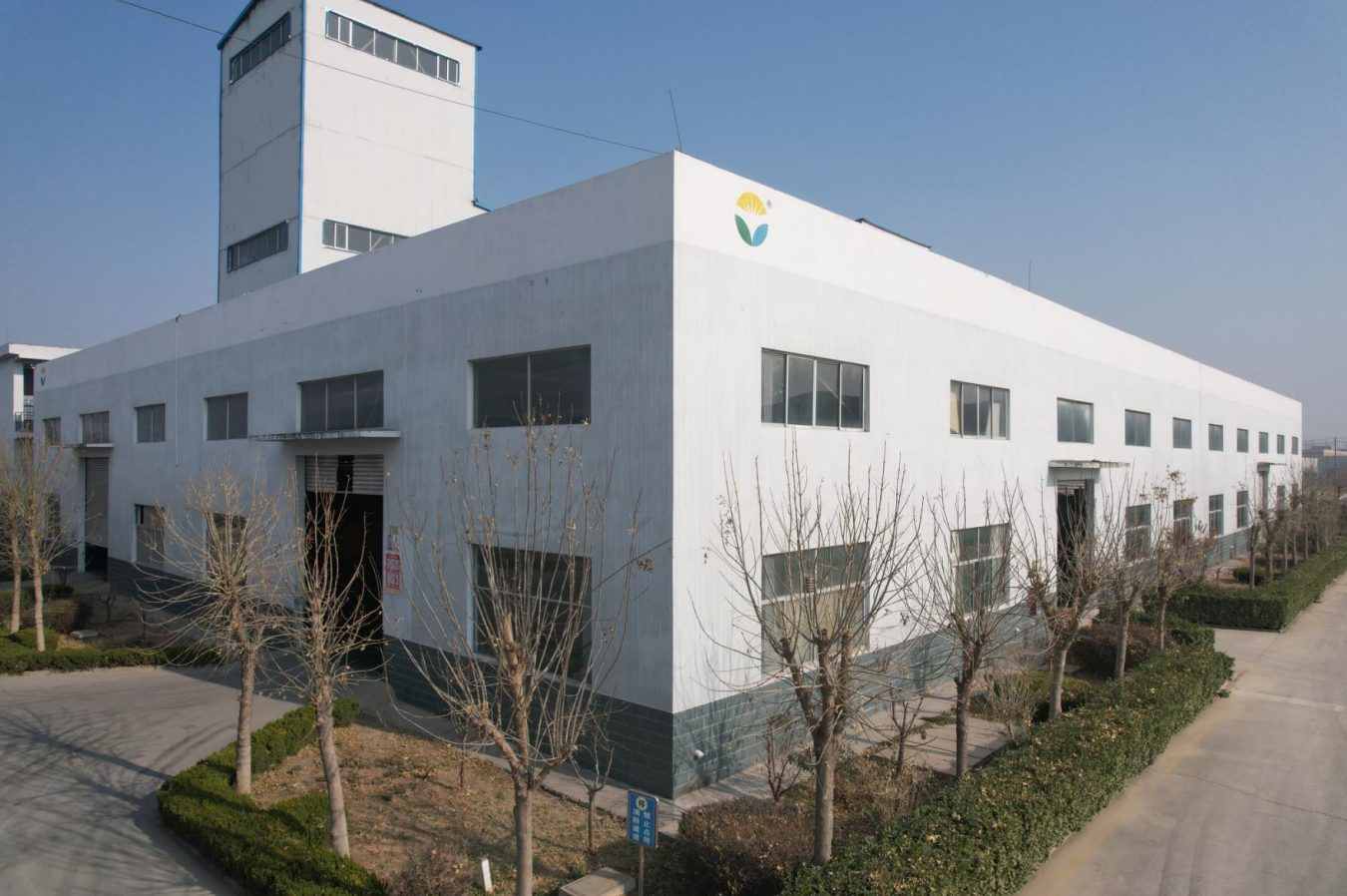
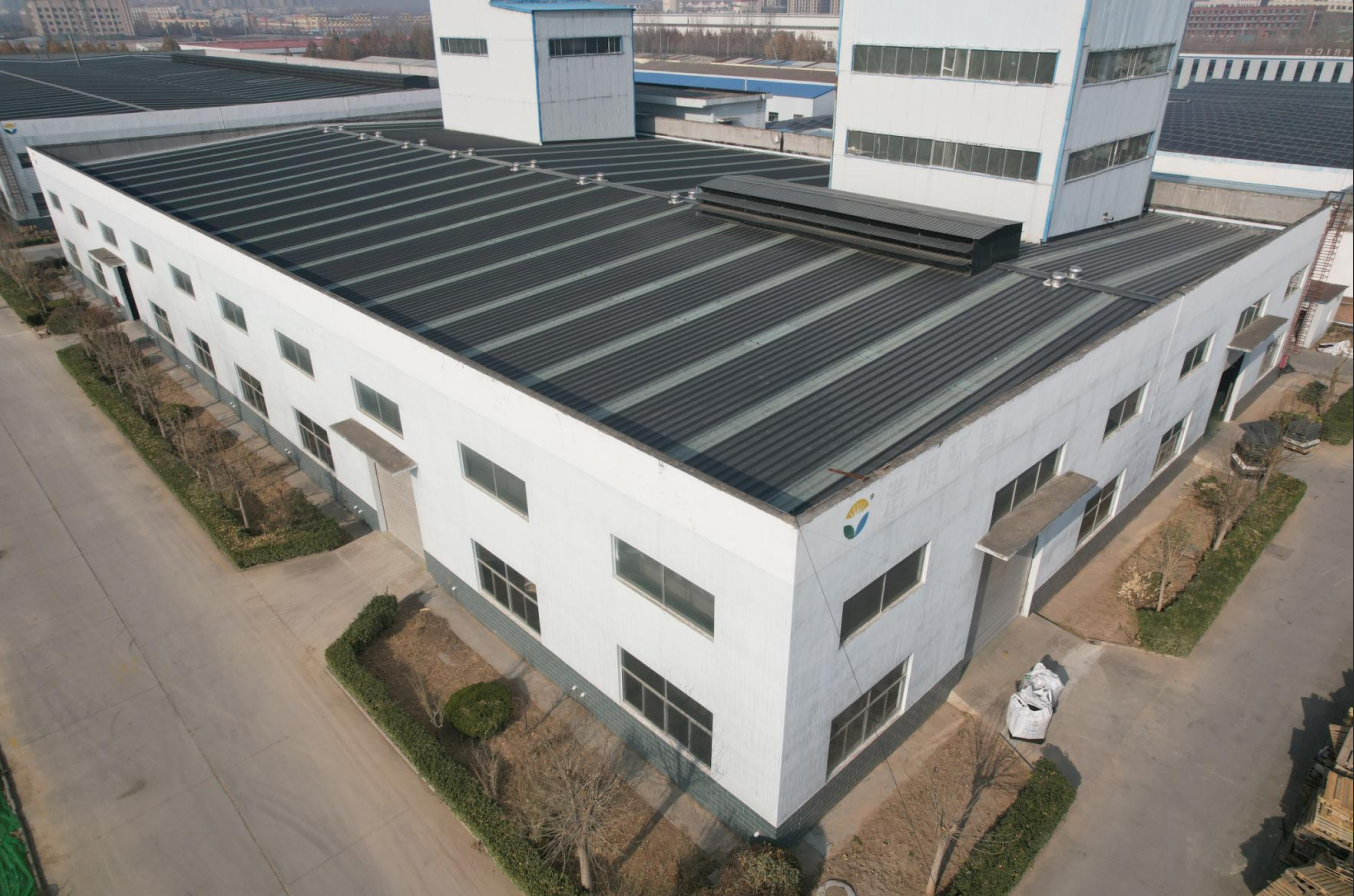
Haoyang's publicly stated manufacturing footprint is a 200,000 m² factory with 190 employees and 33,000 t annual output, supported by 20 engineers and cooperative work with universities including Fudan University and Tianjin University of Technology. For this product category the company reports a six-metre-wide composite drainage network production line, monthly capacity of 3,000 t, a minimum order quantity of 5,000 m², a lead time of 10–30 days, 100% testing and on-site after-sales support. Those figures describe capacity and process, not the performance of any individual roll — the performance still has to come off the datasheet and test report for the exact specification ordered.
Published company figures for the drainage geonet line give thickness of 4.0–8.0 mm, mass per unit area of 500–1,400 g/m², tensile strength of ≥5–15 kN/m, compressive strength at 10% strain of ≥500–830 kPa, and drainage capacity of ≥50–120 (L/min)/m, all stated as customizable. They are company-reported values from a product page dated 2022, and the page does not publish the test standard, load duration, hydraulic gradient or normal stress behind the compressive and flow figures. Independent technical literature on biplanar geonets cites a comparable envelope — 4–8 mm thickness, transmissivity in the 10⁻³–10⁻² m²/s range under ASTM D4716, and compressive strength of 500–1,000 kPa — but that is a general industry range for biplanar products, not a like-for-like test of a specific Haoyang roll. The two sets of numbers should not be placed side by side as if they were measured the same way.
Two standards are useful as procurement scaffolding rather than as proof. ASTM D7931/D7931M-21a is listed as a standard guide for specifying drainage geocomposites, and ASTM D7273/D7273M-08(2026) as a standard guide for acceptance testing requirements for geonets and geonet drainage geocomposites. Both are guides: they help a buyer write a specification and an acceptance plan, but a catalogue listing is not evidence that a product complies.
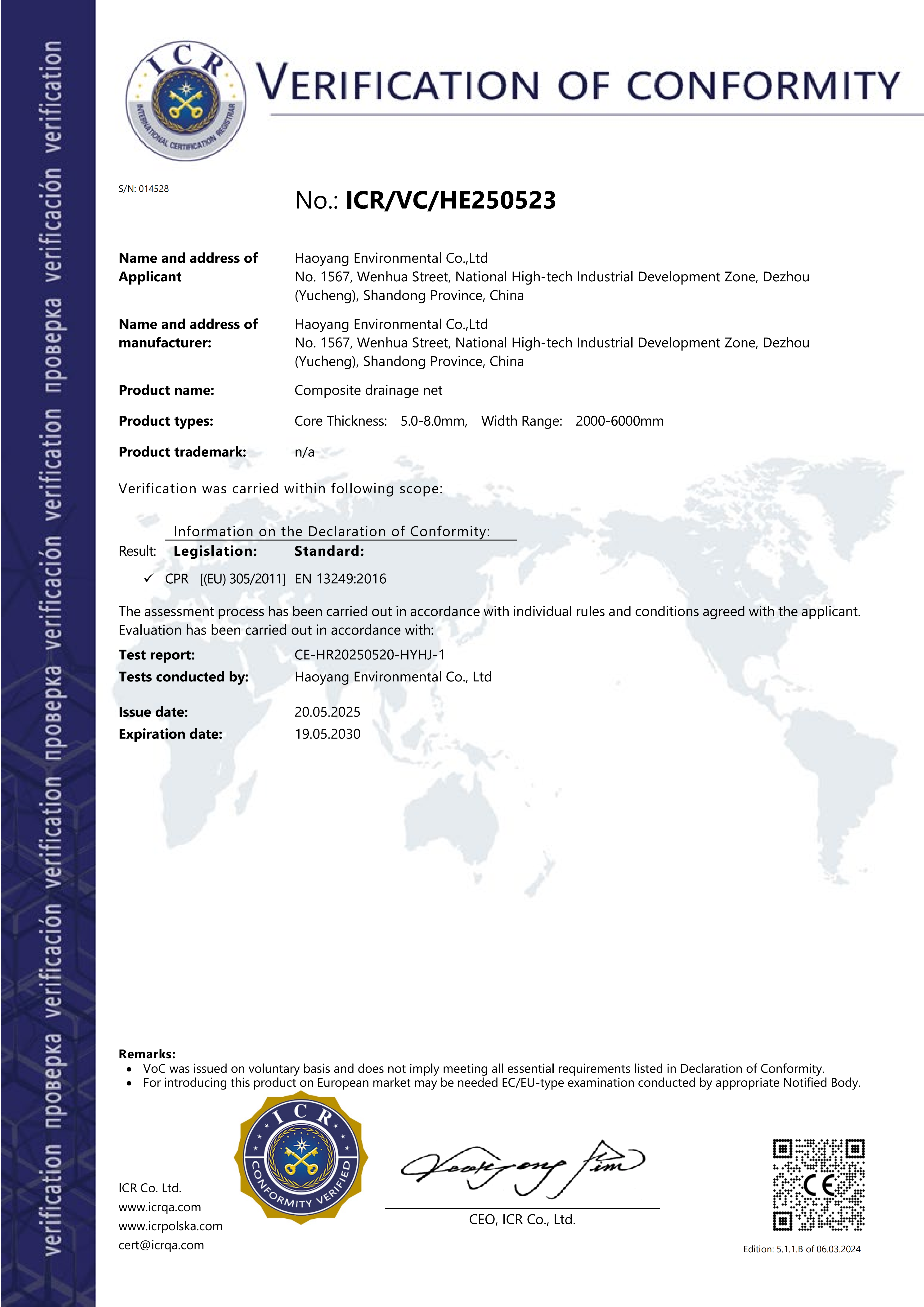
For market access, the certificates that matter are conformity documents tied to a named product family and a named standard. Haoyang holds an ICR Verification of Conformity, certificate ICR/VC/HE250523, for a composite drainage net compliant with EN 13249:2016, issued 20 May 2025 and valid to 19 May 2030, covering the EU/EEA market. Related Haoyang ICR certificates for geotextile, geomembrane and GCL name both EN 13249:2016 and CPR (EU) 305/2011, so the CPR reference belongs to those scopes rather than automatically to the drainage net scope. For the EAEU and Russia, a GOST Certificate of Conformity issued by ПрофСерт (ProfSert) covers the 3D composite drainage geonet to GOST 33068-2014, issued 1 June 2022 and valid to 22 May 2028; the geotextile component is covered by a separate GOST certificate, POCC CN.32682.041C00.OC01.H00839, to the same standard, valid from 23 May 2025 to 22 May 2028. Reading which product family, standard and validity period each document names is the check — not simply counting certificates.
The five variants, ranked by severity of duty
Rank 1 — High-strength polypropylene composite drainage geonet
This is the variant to start from when mechanical survival is the binding constraint and chemistry is a secondary but real concern. A high-strength polypropylene geotextile face gives the composite its abrasion, puncture and tensile margin during installation over prepared subgrade and under coarse tailings, while the PP polymer is the more chemically conservative choice of the two common geotextile polymers for prolonged contact service. It ranks first because it addresses the largest number of severity factors simultaneously and because there is documented project evidence behind it.
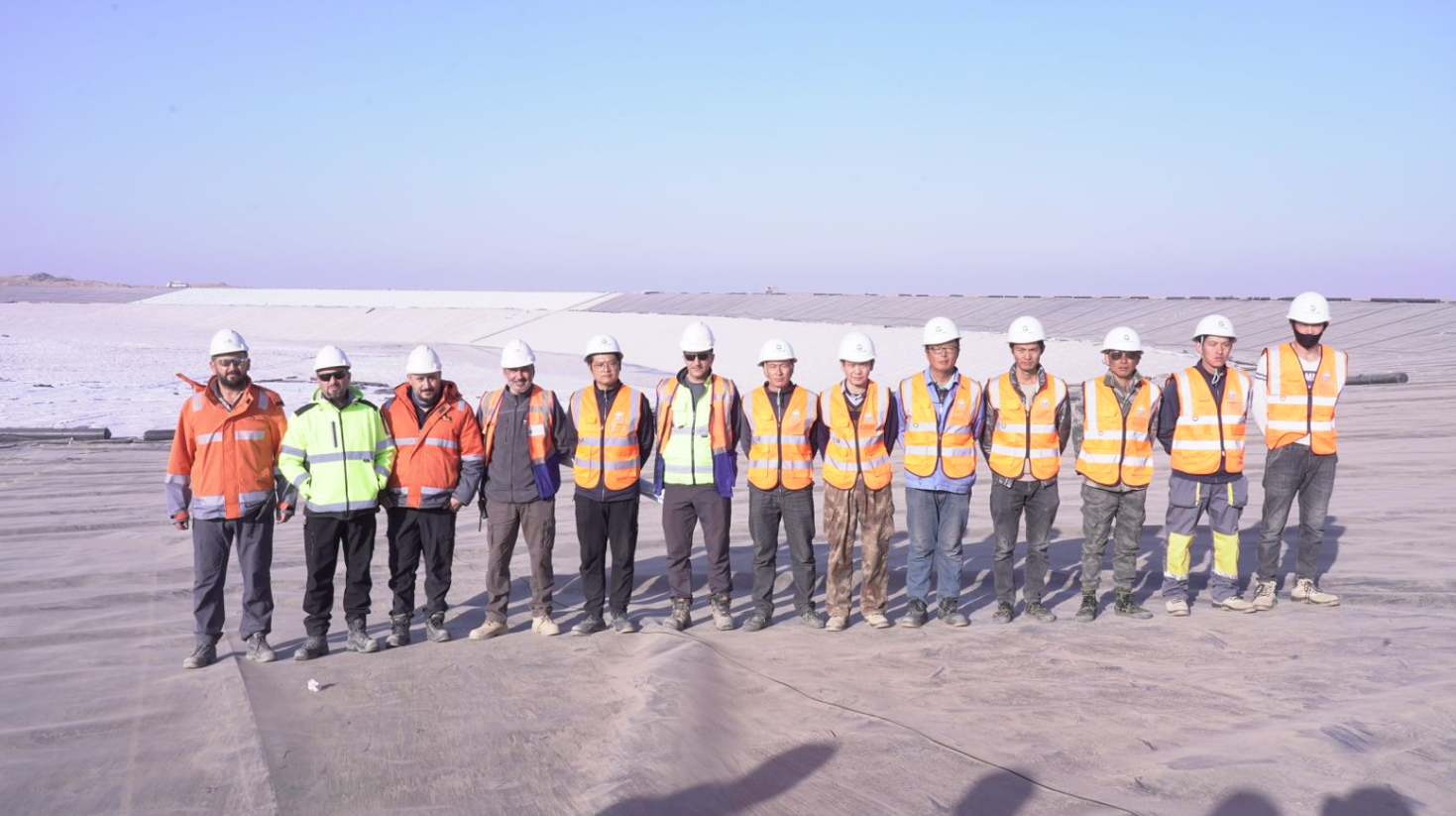
That evidence is a 900,000 m² gold mine tailings pond basin seepage control project in Uzbekistan, where the system used a three-dimensional composite drainage network built from textured geomembrane and high-strength polypropylene geotextile, delivered through a full-chain service model running from material supply to on-site installation. The project is evidence of a delivered configuration in a tailings environment; it is not a published performance test, and it does not by itself certify the variant for a different ore body or a different cover depth. Treat it as proof of application experience, then verify the specification for your own cell.
Verify before approval: the tensile and tear values for the exact geotextile mass ordered, the compressive strength at your design normal stress, and whether the ICR scope (EN 13249:2016) and the GOST scope (GOST 33068-2014) name the product family you are buying.
Rank 2 — Acid/alkali-resistant composite drainage geonet
Where the contained medium is chemically aggressive, chemistry becomes the dominant severity factor and this variant moves to the front of the evaluation. The requirement covers both faces of the composite: the geotextile filter and the HDPE core both sit in the same pore fluid for the life of the facility, and the drainage function fails if either loses integrity.
This variant ranks second rather than first for a specific reason: the published evidence is thinner than the mechanical evidence. Haoyang's product page states acid/alkali resistance of ≥90% strength retention, but the page does not disclose the exposure medium, concentration, temperature, duration or test method, so the figure cannot be used directly for design or to compare against another supplier's chemical-resistance claim. That is a documentation gap, not an indication that the product is unsuitable. It does mean the variant should never be approved on a catalogue number alone.
Verify before approval: a project-specific immersion or chemical-resistance test report that names the actual medium, concentration, temperature and duration, with retained tensile strength measured before and after exposure. If the medium is a leachate rather than a defined reagent, ask for the test protocol used to represent it.
Rank 3 — High compressive resistance drainage geonet
When the design load dominates — deep cover over the liner, thick tailings lifts, heavy trafficking during construction — the question is not whether the geonet drains when new, but whether its flow channels stay open under sustained normal stress. Compressive behaviour governs this, which is why the variant is specified on compressive strength at a defined strain plus retained flow under that same load, not on thickness alone.
Haoyang's published range states ≥500–830 kPa compressive strength at 10% strain, again without the load duration, specimen configuration or test standard. The industry envelope for biplanar geonets reported in independent literature is 500–1,000 kPa, but that figure comes from a different test basis and a different product class, so the two are not directly comparable. The practical reading is that the range is plausible for high-load work and is worth an RFQ, provided the supplier supplies the test conditions behind the value.
Verify before approval: compressive strength and retained transmissivity measured at the project's design normal stress and hydraulic gradient, with the test standard stated. Creep behaviour under long-term load is a separate question and should be requested explicitly.
Rank 4 — High drainage capacity 3D composite drainage geonet
Flow-dominant duty is different again. Where inflow is high, the drainage path long, or gas must be relieved quickly beneath a liner, the limiting property becomes transmissivity at the working stress rather than compressive strength on its own. A three-dimensional core with a larger void structure is the usual answer, and the specification should be written as a required flow rate at a stated gradient and normal stress.
Haoyang publishes drainage capacity of ≥50–120 (L/min)/m, described as customizable, with the hydraulic conditions not stated on the page. For comparison, independent literature reports transmissivity of 10⁻³–10⁻² m²/s under ASTM D4716 for biplanar geonets — a different unit and a different test basis, so the comparison is directional only. What matters for approval is a single number delivered under your design conditions.
Verify before approval: a transmissivity report at the design normal stress and gradient, plus the safety factor used to derate intake flow for clogging and long-term creep. Ask also whether the geotextile specification was checked against the actual fill or tailings gradation.
Rank 5 — Polyester filament composite drainage geonet
The polyester filament composite is the moderate-duty option in this ranking: it suits filtration-critical service under moderate load and moderate chemistry, where the buyer's priority is a stable nonwoven filter and controlled cost rather than maximum mechanical or chemical margin. It ranks fifth because it clears fewer severity factors, not because it is a lesser product — in the right application it is the correct and more economical choice.
Polymer selection is the decision point here. PP and PET behave differently across chemical exposures, and the geotextile's suitability for a specific medium should be confirmed against the supplier's resistance data for that medium rather than assumed from the polymer name. Where the contained fluid is strongly aggressive or the cover load is high, the higher-ranked variants are the safer starting point.
Verify before approval: filtration compatibility with the surrounding soil or tailings, polymer resistance data for the actual medium, and the same compressive and flow evidence required of the other variants at the project's design stress.
Step-by-step: specifying and verifying the chosen variant
The sequence below turns the ranking into a defensible specification. It assumes the drainage layer sits inside an anti-seepage system and will be buried, so each step produces a document rather than an opinion.
- Define the exposure. Record the pore fluid chemistry, its variability across the basin or cell, and the design life. This decides whether the acid/alkali variant is mandatory or whether a standard composite is adequate.
- Define the load. Convert cover depth and fill density into a design normal stress, and add construction loading. This decides whether compressive resistance is the governing property.
- Define the flow. Calculate the required discharge from inflow and drainage-path length, apply a safety factor for clogging and long-term creep, and state the required transmissivity at the design stress and gradient. This decides whether a high drainage capacity 3D core is needed.
- Select the structure. Choose biplanar or triplanar core, single- or double-sided heat-bonded geotextile, and the geotextile mass and polymer. Confirm that the selected combination is actually producible at the required thickness, mass and width — Haoyang lists thickness, GSM, width, scroll length, tensile yield and fracture strength, piercing strength and chemical and physical indicators among customizable parameters.
- Collect the documents. Request the ICR verification (EN 13249:2016), the GOST certificate to GOST 33068-2014 where the EAEU market applies, and test reports for compressive strength, transmissivity and chemical resistance with conditions stated. Confirm the certificate names the product family being supplied.
- Approve on sample and first-article data. Test the delivered roll against the approved specification, check the heat-bonded lamination for delamination, and confirm roll dimensions, mass and marking. Ask how bond integrity is controlled in production if the specification depends on it.
Where each variant fits in practice
Smelting tailings and process containment. This is the highest-severity environment in the ranking and normally calls for Rank 1 or a Rank 1 plus Rank 2 combination: high-strength polypropylene composite for mechanical survival, with chemical resistance confirmed for the actual tailings chemistry. Haoyang's reference work in this sector includes the Uzbekistan gold mine tailings basin, the Yunnan Heqing Beiyao gold mine tailings pond expansion anti-seepage project, and the Minmetals 23rd Metallurgical copper-gold project in Eritrea, alongside red mud, phosphogypsum and fly-ash containment work.
Landfill and environmental containment. Landfill cells combine moderate-to-high compressive load with leachate chemistry, so Rank 2 or Rank 3 usually leads, with the flow requirement set by leachate generation and the drainage path across the base. The same logic applies to hazardous-waste and industrial storage basins, where the drainage layer also protects the geomembrane from the fill above it.
Subgrade and road works. Here loads are transient but repeated, and the drainage function is to remove water from beneath the pavement structure and prevent pumping of fines. A subgrade drainage geonet with a correctly matched filter is normally adequate; the compressive requirement is set by construction traffic and pavement depth rather than by deep cover.
Tunnel and slope drainage. Tunnel applications need gas and water relief against the lining with a drainage path that follows the arch, which is a flow-dominated duty suited to the high drainage capacity 3D composite. Slope protection and retaining-wall drainage combine flow with a filter that must not clog against the retained soil, so the geotextile specification carries much of the risk.
Variant comparison at a glance
The table summarises the ranking, the duty each variant is selected for, its function inside the anti-seepage system, and the documentation to request. Values quoted are company-reported ranges published by Haoyang unless attributed otherwise, and each should be confirmed for the exact specification ordered.
| Rank | Variant | Duty it is selected for | Anti-seepage function | Documentation to request |
|---|---|---|---|---|
| 1 | High-strength polypropylene composite drainage geonet | Coarse tailings, heavy cover, high installation and tear risk | Pressure relief plus mechanical protection of the liner | Tensile and tear data for the ordered mass; ICR to EN 13249:2016; GOST 33068-2014 where applicable |
| 2 | Acid/alkali-resistant composite drainage geonet | Aggressive leachate or process fluid | Maintains drain integrity under chemical exposure | Chemical-resistance report naming medium, concentration, temperature and duration |
| 3 | High compressive resistance drainage geonet | Deep cover, thick fill, sustained normal stress | Keeps flow channels open so head does not build on the membrane | Compressive strength and retained transmissivity at design stress, with test standard stated |
| 4 | High drainage capacity 3D composite drainage geonet | High inflow, long drainage path, gas relief | Removes water and gas quickly across a large liner area | Transmissivity at design gradient and normal stress, plus clogging safety factor |
| 5 | Polyester filament composite drainage geonet | Moderate load and moderate chemistry, filtration-critical | Stable filter plus drainage in less aggressive service | Filtration compatibility with the fill, polymer resistance data, standard mechanical reports |
Frequently asked questions
Which certificates should an EU or EAEU anti-seepage project check on a drainage geonet?
For the EU/EEA, check an ICR Verification of Conformity that names the product family and the standard. Haoyang's composite drainage net certificate is ICR/VC/HE250523, issued 20 May 2025 and valid to 19 May 2030, stating compliance with EN 13249:2016. Haoyang's related ICR certificates for geotextile, geomembrane and GCL cite both EN 13249:2016 and CPR (EU) 305/2011, so confirm which standard is named in the scope you are relying on. For the EAEU and Russia, check a GOST Certificate of Conformity to GOST 33068-2014 issued by ПрофСерт (ProfSert), valid to 22 May 2028 for the 3D composite drainage geonet, plus the separate geotextile certificate POCC CN.32682.041C00.OC01.H00839 valid to 22 May 2028. A certificate supports market access; it does not replace project-specific test reports.
Can a composite drainage geonet be customized for a smelting or tailings specification?
Yes, within the manufacturer's stated customization scope. Haoyang lists LOGO, width, scroll length, thickness, GSM, tensile yield strength, tensile fracture strength, piercing strength, and chemical and physical indicators as customizable parameters, with production run as OBM, monthly capacity of 3,000 t, 100% testing and on-site after-sales support. Customization changes the specification, so each customized parameter needs its own test report; a certificate issued for a standard configuration does not automatically cover a modified thickness, mass or width.
What drives the price of a drainage geonet variant?
Price follows the specification: core thickness and structure, geotextile polymer and mass per unit area, roll width and length, the amount of testing and documentation required, and order volume against the 5,000 m² minimum order quantity. As an external benchmark only, a 2026 commercial price survey based on vendor solicitations reported a range of about US$1.60–10.76 per square metre for drainage geonet materials; that range reflects mixed specifications and sourcing platforms and is not a quotation for any specific roll. A third-party benchmark of this kind is useful for budgeting, but the only figure that applies to your project is a formal quotation for the exact thickness, mass, width and documentation package.
How should a buyer validate a variant before placing a full order?
Validate in three layers. First, documents: the ICR and GOST scopes, plus compressive, transmissivity and chemical-resistance reports with test conditions stated. Second, samples: test the delivered sample against the approved specification, check roll dimensions and mass, and examine the heat-bonded lamination for delamination. Third, production evidence: confirm the line, the testing regime and traceability, since a six-metre-wide composite drainage network line supports wide-roll supply but does not by itself prove output, schedule or quality records. A factory audit or third-party inspection closes the gap between a datasheet and a delivered roll.
What lead time and delivery support should be expected?
Haoyang states a 10–30 day lead time, a 5,000 m² minimum order quantity and on-site after-sales support, with export activity reported at 60% of output across Africa, Europe, Central Asia, Southeast Asia, Australia and South America. Lead time is quoted from order confirmation, so it should be confirmed in writing against your construction sequence, especially where installation support or a staged delivery is required. If the project needs a project-specific test programme or a customized roll, request the sample and quotation package early enough to cover both the production slot and the testing time.
Conclusion
The ranking is a starting point for evaluation, not a substitute for the specification. High-strength polypropylene composite leads because smelting and tailings duty loads mechanical, hydraulic and chemical stress at the same time and that variant has delivered project evidence behind it; acid/alkali-resistant composite comes next where chemistry dominates, but only once a project-specific resistance test closes the documentation gap; high compressive resistance and high drainage capacity 3D composite follow according to whether load or flow governs; and the polyester filament composite is the sensible moderate-duty choice where neither is extreme.
Whichever variant is shortlisted, the approval decision rests on the same three things: a specification written against your own chemistry, load and flow; test reports whose conditions match that specification; and certificates whose scope names the product family you are buying. Haoyang Environment Co., Ltd (haoyanghuanjing.com) publishes its certificate numbers and product ranges for that verification, and a sample request or specification review is the practical next step before a full order is confirmed.
Have Questions or Need More Details?
Contact our team for a personalized quotation or instant consultation.
Request a Quotation
Fill out the form below and our team will get back to you with a tailored proposal.
WhatsApp Direct Chat
Prefer to chat in real-time? Message us on WhatsApp for instant assistance & quick answers.
- Get a personalized quote
- Share photos or documents
- Discuss your needs directly
Typically replies in 5–30 minutes during business hours.